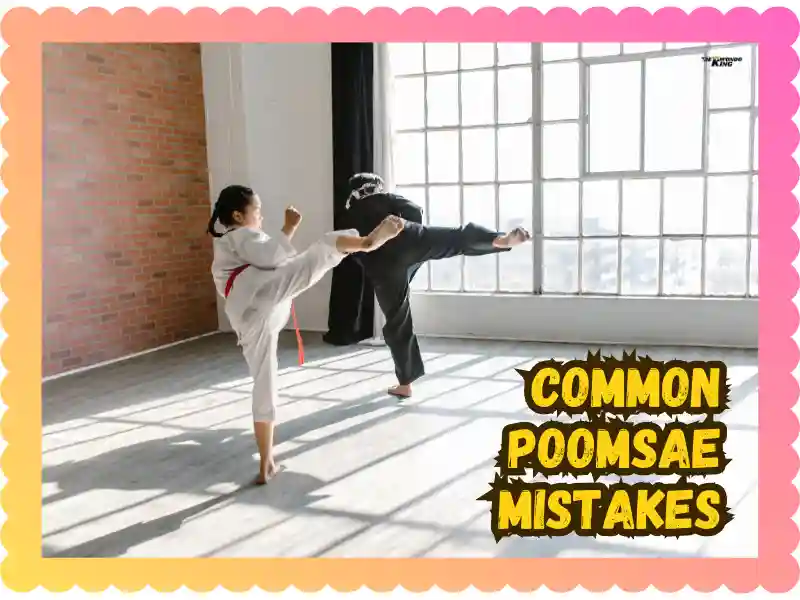
A quiet sports hall in Birmingham is where I first learned this lesson. It was a Sunday morning. The sun hit the polished floor. We all stood in neat lines with our belts tied tight. I thought my form was perfect. I moved fast and kicked hard. But when the scores came back, I was shocked. My speed had hidden my flaws. Many students across the UK face this same thing. We focus on the “flashy” bits and miss the small details. Learning about common poomsae mistakes is the first step to a better grade. It helps you stay calm when the judges are watching. Let us look at how to fix these errors together.
Why Poomsae Mistakes Matter More Than You Think
Poomsae errors don’t just lose points on a scorecard. They quietly cap your progress and stop you from feeling truly confident on the mats.
How Judges in the UK Actually Score Poomsae
In a UK tournament or grading, judges look for two things: accuracy and presentation. Accuracy is about doing the right move in the right stance. Presentation is about how it looks. Many colour belts think being “fast” is the same as being “good.” It isn’t. A slow, perfect form will always beat a fast, messy one. At a club grading, your instructor wants to see that you understand the basics. In a competition, the judges want to see power and snap.
The Emotional Cost of Repeating the Same Mistakes
It is very frustrating to train hard but stay stuck at the same level. You might wonder why your friend got their blue belt while you are still waiting. Small mistakes become habits very quickly. If you don’t fix them now, they become “ghosts” that haunt your training for years. This can drain your confidence before a big day.

The Most Common Poomsae Mistakes Beginners Make
These errors show up everywhere. I see them in white belts in Leeds and green belts in London.
Rushing Through Movements
When we get nervous, we go faster. It is a natural human reaction. But in poomsae, rushing makes you look out of control. You lose the “finish” of each technique. To fix this, try to count to two in your head for every stance. Slowing down shows the judges that you are the boss of your own body.
Incorrect Stances (Too Short, Too Tall, Too Narrow)
The floor is your foundation. I often see front stances that look like a normal walking step. They are too short. Other times, students stand too tall and lose their balance. Your legs should feel the pressure through the heel. This keeps you stable. If your stance is too narrow, you will wobble like a leaf in the wind.
Forgetting Breathing and Rhythm
Many beginners hold their breath. You can see their faces turn red! This makes your muscles tight. A quiet hall should be filled with the sound of sharp, controlled breathing. Rhythm is what makes poomsae beautiful. Every move should not have the same speed. There should be a flow, like a song.
Technical Poomsae Errors Judges Notice Instantly
Judges have “martial arts eyes.” They spot these technical flaws before you even finish the first line of the form.
Poor Chambering and Re-Chambering
Your arms should not just “appear” in a block. They must start from a specific place. This is called the chamber. Lazy arms that float around look messy. A neat, tight chamber raises your presentation score instantly. It shows you have discipline.
Inconsistent Height and Balance
If your head bobs up and down like a boat on the sea, you are losing marks. You should stay at the same height while moving between stances. When your shoes squeak loudly on the sports hall floor during a turn, it often means your weight is in the wrong place. Keep your centre of gravity low.
Weak or Overextended Blocks
A block should stop where the attack would be. I often see students locking their elbows too hard. This is bad for your joints and kills the “snap.” It also makes the block look stiff. Your arm should be slightly bent and strong, not like a piece of wood.
Turning, Direction, and Line Errors in Poomsae
Straight lines are much harder than they look. This is especially true when you are under pressure during a grading.
Drifting Off the Floor Pattern
Have you ever finished a form and realised you are three feet away from where you started? This is very common. It usually happens because your steps are too wide. To fix this, imagine a straight line of tape on the floor. Try to keep your feet on either side of that line.
Slow or Messy Turns
Turning is where balance is tested most. Many students move their upper body before their feet. This makes you wobble. You should pivot on the ball of your foot. Let your hips drive the turn. A sharp turn reveals that you have real skill and core strength.
Timing, Power, and Control Mistakes
This is where a “good” poomsae becomes an “impressive” one. It is all about how you handle your energy.
Using Too Much Power Everywhere
If every move is done at 100% power, the form becomes exhausting to watch. It also lacks “contrast.” Judges want to see you relax between moves. Relaxation is a skill. It allows the final “snap” of the punch to look even faster.
No Pause Where It Matters
A form needs micro-stops. These are tiny pauses that show you have finished a move. Without them, the form feels rushed. It looks like you are just trying to get it over with. Think of these pauses as the “full stops” in a sentence.
Common Poomsae Mistakes by Belt Level
Different belts repeat different errors. It is a natural part of growing in the sport.
White to Yellow Belt Errors
At this level, students often forget which block comes next. They also tend to look at the floor. This shows a lack of confidence. Don’t copy the person in front of you. Lead with your own rhythm.
Green to Blue Belt Errors
Now you know the moves, but you might overthink the names. This causes a “confidence wobble.” You might lose your flow because you are trying too hard to be perfect. Stay relaxed and let your body remember the path.
Red Belt and Above Errors
Senior belts sometimes try to look “too advanced.” They over-tense their muscles to look strong. This makes the movement look fake. Accuracy should always come before style. Even a black belt must get the basic front stance right.
British Expert Insight on Poomsae Mistakes
I spoke with a top coach in Manchester about what he sees from the judge’s chair.
“Most poomsae mistakes aren’t about knowledge. They’re about rushing because you want to impress. Calm always scores higher. In the UK, we value the basics. If your foundation is solid, the rest will follow.”
— Master Daniel Harper, WT Level 3 Coach, Manchester
Common Poomsae Mistakes and How to Fix Them
After watching dozens of UK gradings, I have seen these patterns repeat. Here is a quick guide to help you.
| Mistake | Why It Happens | Simple Fix |
| Rushing movements | Nerves or copying others | Count “one-two” silently for each move |
| Short stances | Fatigue or old habits | Check your foot distance against your shoulders |
| Weak chambers | Lack of awareness | Pause for a split second at the start of a block |
| Poor balance | Core is disengaged | Practise your form in slow motion |
Training Habits That Cause Repeated Poomsae Mistakes
Sometimes the mistake isn’t the move itself. It is how you spend your time in the dojang.
Always Training at Full Speed
If you only ever train fast, your muscle memory never really forms. You are just “glossing over” the errors. You need “slow days.” Training in slow motion allows you to feel exactly where your feet are. It is the best way to build a solid form.
Never Practising Alone
If you always follow the instructor’s count, you aren’t learning the form. You are just reacting. Practice alone in a quiet corner. This builds independence. It also gives you the confidence to lead the line during a grading.
How to Self-Correct Poomsae Mistakes at Home
You don’t need a huge hall to get better. Your living room or garden is fine.
Using Mirrors, Video, and Floor Markers
Mirrors are good for checking your hand height. But video is even better. Film yourself on your phone. You will see things you never noticed before. A simple piece of tape on the carpet can also help you keep your lines straight.
Mental Rehearsal and Walk-Throughs
You can “walk” through your form while making a cup of tea. You don’t even need to use your arms. Just focus on the steps and the turns. This builds the mental map of the pattern without making your legs tired.
Competition vs Grading , Different Mistakes, Same Forms
The pressure is different, and so are the errors.
Grading Day Errors
Students often watch the examiners too much. They are looking for a nod of approval. This breaks your focus. Also, many people forget to “Kihap” loudly. A strong shout shows the examiner that you are not afraid.
Competition Day Errors
In a tournament, people speed up without knowing it. The adrenaline makes you move like a rabbit! You might also try to “push” your power too much. If you make one mistake, don’t let it ruin the rest. Keep your composure and finish with pride.
2026 Judging: The -0.1 vs. -0.3 Point Thresholds
In the current UK Poomsae competitive landscape, the difference between a Gold medal and missing the podium often comes down to less than 0.5 points. Under 2026 British Taekwondo Scoring Guidelines, mistakes are categorized with surgical precision.
1. The “Small Mistake” (-0.1 Deduction)
These are minor technical inaccuracies where the technique is recognizable but poorly executed.
- Footwork Neglect: Sliding the heel during a stance transition or failing to pivot the base foot correctly in a Dollyo-chagi.
- Chambering Issues: If an Arae-makki (low block) starts too high or too far from the hip, it’s an automatic minor deduction.
- Eye Contact: Looking at the floor during a transition instead of maintaining a steady gaze toward the “opponent.”
2. The “Serious Mistake” (-0.3 Deduction)
Serious mistakes represent a failure to perform the fundamental action of the pattern.
- Wrong Stance: Performing a Juchum-seogi (sitting stance) when the pattern requires a Dwit-gubi (back stance).
- Missing Kihap: Forgetting the yell or placing it at the wrong movement in the sequence.
- Balance Loss: A significant wobble that requires the athlete to step out of their stance to recover.
3. Presentation Score: The 2026 Volume Factor
Presentation (scored out of 6.0 in 2026 para and standard rules) focuses on Expression of Energy. A common mistake for UK students is focusing so much on accuracy that they lose “Volume of Movement.”
- Control of Power: You must show a “soft” start and a “hard” finish.
- Rhythm: The tempo should not be robotic. In 2026, judges are looking for the “breathing connection”—using your exhalation to accentuate the final snap of the technique.
4. Checklist for Your Next Grading
Before you step onto the mat in New Kensington or London, audit your form against these three “Score-Killers”:
- The Lead Foot: Is it pointing 12 o’clock in your Ap-kubi?
- The Reaction Hand: Is it pulled tightly to the hip or is it “lazy”?
- The Kick Height: Are your kicks consistently at In-jung (nose) level for Eolgul targets?
Expert Insight: In 2026, judges are increasingly penalizing “flick kicks” in Poomsae. Ensure your knee is fully chambered before the extension and fully retracted before the foot touches the floor to avoid a “Lack of Control” penalty.
When Mistakes Are Actually Signs of Progress
Oddly enough, making mistakes can mean you are getting better.
Breaking Old Habits
When you try to fix a bad stance, it will feel very awkward at first. Your technique might even feel “worse” for a week. This is normal. Your body is re-learning how to move. Stick with it.
Growing Awareness
The moment you notice your own mistake mid-form, you have improved. It means your brain is starting to see the details. Self-correction is a sign of a high-level student. It shows you are paying attention to the right things.
Thoughts on Common Poomsae Mistakes
Everyone makes them. Even the Masters who grade you once made these same errors. The difference is that the best students choose to fix them. Don’t be afraid of the “boring” basics. Accuracy is much more important than force. If you stay calm and watch your lines, you will stand out for all the right reasons.
Final Recommendation
Do not let these common poomsae mistakes hold you back from your next belt. Take a moment to record your form on your phone this week. Watch it back and check your stances against a diagram. You will soon see where you can gain easy marks. It is the best way to turn a shaky form into a winning one.
FAQs
Many rush moves and skip clean stances. Hands drop, feet drift, and timing slips. Slow down and focus on neat basics first.
Poor stance width or bent posture causes wobble. Keep knees soft and back straight. Strong base means better balance and power.
Yes, uneven rhythm hurts flow and marks. Moves should link smoothly, not stop-start. Count beats to keep a steady pace.
Hands often float or miss targets. Snap blocks and punches to clear points. Practise in front of a mirror to tidy lines.
Memory gaps come from low reps or nerves. Break the form into parts and drill daily. Muscle memory builds calm and recall.
Yes, steady breathing keeps you relaxed and sharp. Exhale on strikes and blocks. Good breath control improves focus and power.
Run full forms slowly, then at speed. Ask a coach to check details. Small fixes each day lead to cleaner, confident poomsae.

Founder, Owner, and CEO of TaekwondoKing.
He is one of the top 100 martial artists in the World and among the top 20 referees in Bangladesh.
Ehatasamul Alom is an esteemed Kukkiwon Certified Taekwondo 3rd Dan Black Belt with over 15 years of experience in this dynamic martial art. Born in Rajshahi, Bangladesh, Ehatasamul’s journey with Taekwondo began at the tender age of seven. His passion led him to compete at national and international levels, where he has bagged numerous awards and honors. He is also a member of the Taekwondo National Referee Panel.
With a Bachelor’s degree in Sports Science from the prestigious Rajshahi University, Ehatasamul has a deep understanding of the technical and scientific aspects of martial arts and some other martial arts.
In 2022, Ehatasamul created the “TaekwondoKing.com” to share his knowledge, Free Resources, Values, and Real experiences. His articles focus on Taekwondo training techniques, competition strategies, Sport Products Reviews, and the art’s rich history and philosophy. He also writes about the importance of mental fortitude and discipline, key aspects of his teaching philosophy. He has already launched many sports, Taekwondo, and health-related Free online tools. His goal is to inspire both beginners and seasoned practitioners worldwide through insightful and engaging content.
If you need any help, contact Ehatasamul Alom at any time.