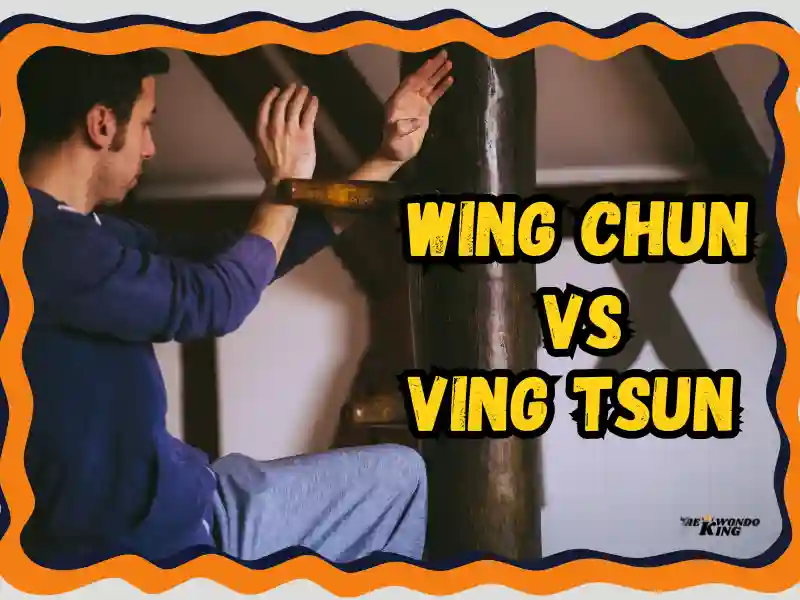
Have you ever noticed how different martial arts can have such similar names, yet they’re not quite the same? It’s a bit like how we in Miami might call something one thing, and someone in NY City calls it another, even if it’s the same dish! That’s exactly what happens when you compare Ving Tsun vs Wing Chun. As someone who’s delved deep into the world of Wing Chun for years, navigating these nuances became a fascinating part of my journey. Let’s unpack the distinctions and discover what makes each unique.
Recognizing Wing Chun and Wing Tsun can appear confusing in the perplexing world of Chinese Martial Arts, given their shared roots. Ving Tsun vs Wing Chun? However, these two styles are essentially separate in reasoning, strategies, and preparation strategies, reflecting their interesting ancestries and translations.
See the latest Top-Rated Bodyprox Knee Brace Price Today Used by Champions.

Wing Chun vs. Ving Tsun Difference
The Conventional Wing Chun is eminent for its down-to-earth approach to close-range combat, emphasizing productivity, speed, and the vital rule of the centerline hypothesis. This martial art advocates for synchronous assault and defense developments, permitting specialists to neutralize dangers with negligible development. However, with the most extreme adequacy.
Following back to the incredible figures of NG Mui and Yim Wing Chun, this fashion was all-inclusive and popularized by Grandmaster IP Man, Bruce Lee’s coach, subsequently cementing its put-in Martial Arts history. The Advanced Wing Tsun speaks to an advancement of Wing Chun, initiated by Grandmaster Leung Ting, IP Man’s final understudy. This fashion recognizes itself by consolidating logical standards, counting material science and biomechanics, into its combat techniques.
Whereas keeping up the center principles of Wing Chun, Wing Tsun presents a variety of strategies and preparing approaches, custom fitted to advanced combat scenarios and the mental viewpoints of fighting. This adjustment not as it were regards the foundational components of Wing Chun but also expands upon them, exhibiting the style’s flexibility and forward-thinking approach.
Key Distinctions
The essential qualifications between Wing Chun and Wing Tsun lie in their philosophical introductions and academic strategies. Wing Chun remains profoundly established in convention, emphasizing ancestry and the conservation of classical strategies. Alternately, Wing Tsun is characterized by its imaginative soul, permitting a more energetic and versatile elucidation of military standards. These contrasts are not fair specialized, but moreover reflect each style’s approach to the advancing scene of Martial Arts within the modern world.
Ving Tsun vs Wing Chun
Ever wonder why a sign in Leipzig might spell the same art two different ways? In the debate of Ving Tsun vs Wing Chun, the difference is mostly about the lineage and how they translate the Chinese name. I remember being so confused by the spelling until I realized that both paths lead to the same close-range power. As a long-time student of these systems, I can show you how to find the right school regardless of the name on the door.
The Root of Ving Tsun vs Wing Chun
The main split in Ving Tsun vs Wing Chun comes down to who taught the master of the school. “Ving Tsun” is often the spelling used by those following the Wong Shun Leung path, which focuses on raw, scientific combat. “Wing Chun” is the more common name used by the global community and many US schools following various lines from Great Master Ip Man. In the USA, the “Wing Chun” spelling is much easier to find when you search for a local “kwoon” or gym.
- Lineage: Different spellings usually point back to different top-tier teachers in Hong Kong.
- Translation: Both terms mean “Beautiful Springtime,” just written with different English letters.
- Core Goal: Both systems teach you how to guard your center line and use fast, direct strikes.
Summary: The choice between these two names usually indicates a specific historical lineage rather than a completely different martial art.
Comparing Training Styles and Methods
When you look at Ving Tsun vs Wing Chun, you might see a shift in how they drill. Some “Ving Tsun” groups pride themselves on a very hard, “boxing-style” approach to their training. Other “Wing Chun” schools might focus more on the internal flow and the “soft” side of the moves. I have found that my best training days happened when I stopped worrying about the name and focused on the quality of the “Chi Sao” or sticky hands.
| Feature | Ving Tsun | Wing Chun |
| Common Vibe | Practical and Direct | Traditional and Fluid |
| Focus | Combat Efficiency | Skill Development |
| USA Presence | Growing in major cities | Widely available everywhere |
Summary: While training methods can vary between schools, the fundamental mechanics of close-range trapping remain consistent across both spellings.
My Personal View on the Names
I have spent years in the world of Ving Tsun vs Wing Chun, and I can tell you that the teacher matters more than the title. I once visited a small school in Germany that used a rare spelling, but the skill level was higher than any big “brand” I had seen. It taught me that the truth of the art is found in the sweat on the mat, not the ink on the sign. If the moves work and the people are kind, you have found the right home for your journey.
Summary: Prioritizing the quality of instruction over the specific brand or spelling ensures a more productive and authentic martial arts experience.
Is it Ving Tsun or Wing Chun?
Well, they are the same martial art. There’s no distinction at all. A few utilize the more Westernized interpretation of the Chinese characters by spelling it “Wing Chun” and a few utilize the more conventional Chinese interpretation of the characters “Ving Tsun”, which is closer to the Cantonese way of articulating the characters. Either way, you spell it, it can be articulated as “Wing Chun,” and is still a phenomenal framework of self-defense and self-development.
Here at the Foundation, we utilize the spelling “Ving Tsun” to show our association with Sifu IP Ching and our Kung Fu family in Hong Kong, and to maintain the convention of Grandmaster IP Man, who spelled the craftsmanship with the VT spelling in his works on the framework. Sifu IP Ching too employments this spelling for his affiliation, so we do as well.
Ving Tsun the same as Wing Chun?
This martial art is articulated very indistinguishably within the West, but is composed of numerous spellings:
Ving Tsun, Wing Tsun, Wing Tsung, Yong Chun, Weng Chun, Wyng Tjun, Ving Tjun, Wing Tzun, Wing Tschun. Wing Chun is the foremost common shape, utilized to apply to all heredities of this martial art.
Which is more effective, Wing Chun or Muay Thai?
As comparing the viability of Wing Chun and Muay Thai, it’s critical to consider the particular needs and preferences of the person. Wing Chun may be a conventional Chinese martial art known for its close-range combat strategies and emphasis on hand strikes and catching. It also focuses on the centerline hypothesis and fast, productive developments.
On the other hand, Muay Thai may be a martial art from Thailand that utilizes capable strikes utilizing clenched hands, elbows, knees, and shins. It moreover consolidates clinching and tossing methods. Both Martial Arts have their possess qualities and shortcomings, and the effectiveness of each eventually depends on the individual’s training, skill level, and application of the strategies in real-life circumstances. It’s critical to undertake both and see which one resonates best with your fashion and objectives.
See the latest Top-Rated Bodyprox Knee Brace Price Today Used by Champions.
Why does Bruce Lee not use Wing Chun?
There are numerous speculations as to why Bruce Lee halted practicing Wing Chun. A few accept that he found the conventional nature of the martial art as well prohibitive and needed to form his possess one-of-a-kind fashion. Others recommend that he had philosophical contrasts with the Wing Chun framework and needed to investigate distinctive combat strategies.
Notwithstanding the reason, Bruce Lee’s choice to move absent from Wing Chun eventually drove him to create his claim of Martial Arts logic and make the fashion of Jeet Kune Do. This choice permitted him to become a powerful figure within the world of military expressions and set up his possess bequest.
Conclusion
Both Wing Chun and Wing Tsun offer significant bits of knowledge into the craftsmanship of close-range combat, each from an interesting viewpoint. Whether one is drawn to the authentic and conventional angles of Wing Chun or the logical and versatile nature of Wing Tsun, both styles contribute essentially to the Martial Arts taught.
Understanding these contrasts is significant for specialists looking for a military way that adjusts to their objectives and rationalities. As Martial Arts proceeded to adjust and advance, the refinement between Wing Chun and Wing Tsun represents the wealthy differences and dynamism of conventional combat expressions within the present-day period.
But as to any difference in the art, there is no difference at all.
FAQs
Wing Tsun is effective at close range with quick strikes and counters. It’s built for self-defense, not sport fighting. Learn more about how it works in real scenarios.
Wing Chun can struggle against powerful long-range attacks or unpredictable movement styles like boxing or MMA. Learn how to balance its strengths and gaps.
It depends on the fighter and context. Wing Chun excels in close quarters, but boxing often wins with reach, power, and footwork. Explore key style matchups.
Yes, Wing Chun builds coordination, balance, and stamina. It’s low-impact, making it great for all ages. Learn how it benefits both mind and body.
Both are correct! “Wing Chun” is the common spelling; “Ving Tsun” is used in some lineages like Leung Ting’s. Learn why the names differ but the roots stay the same.
Not better, just different. Wing Chun focuses on close-range speed, while Karate emphasizes powerful strikes and form. Compare what suits your style best.
Muay Thai has the edge in raw power and clinch work, but Wing Chun’s speed and trapping are strong up close. Learn more about how they clash in sparring.
In Blox Fruit, Godhuman and Dragon Talon are considered some of the hardest due to the mastery needed and move complexity. Explore style tier rankings.
Krav Maga, Muay Thai, and BJJ top the list for real fights. They’re pressure-tested and cover multiple ranges. Learn how each art handles real-world danger.
See the latest Korean Taekwondo Equipment Price Today.

Founder, Owner, and CEO of TaekwondoKing.
He is one of the top 100 martial artists in the World and among the top 20 referees in Bangladesh.
Ehatasamul Alom is an esteemed Kukkiwon Certified Taekwondo 3rd Dan Black Belt with over 15 years of experience in this dynamic martial art. Born in Rajshahi, Bangladesh, Ehatasamul’s journey with Taekwondo began at the tender age of seven. His passion led him to compete at national and international levels, where he has bagged numerous awards and honors. He is also a member of the Taekwondo National Referee Panel.
With a Bachelor’s degree in Sports Science from the prestigious Rajshahi University, Ehatasamul has a deep understanding of the technical and scientific aspects of martial arts and some other martial arts.
In 2022, Ehatasamul created the “TaekwondoKing.com” to share his knowledge, Free Resources, Values, and Real experiences. His articles focus on Taekwondo training techniques, competition strategies, Sport Products Reviews, and the art’s rich history and philosophy. He also writes about the importance of mental fortitude and discipline, key aspects of his teaching philosophy. He has already launched many sports, Taekwondo, and health-related Free online tools. His goal is to inspire both beginners and seasoned practitioners worldwide through insightful and engaging content.
If you need any help, contact Ehatasamul Alom at any time.