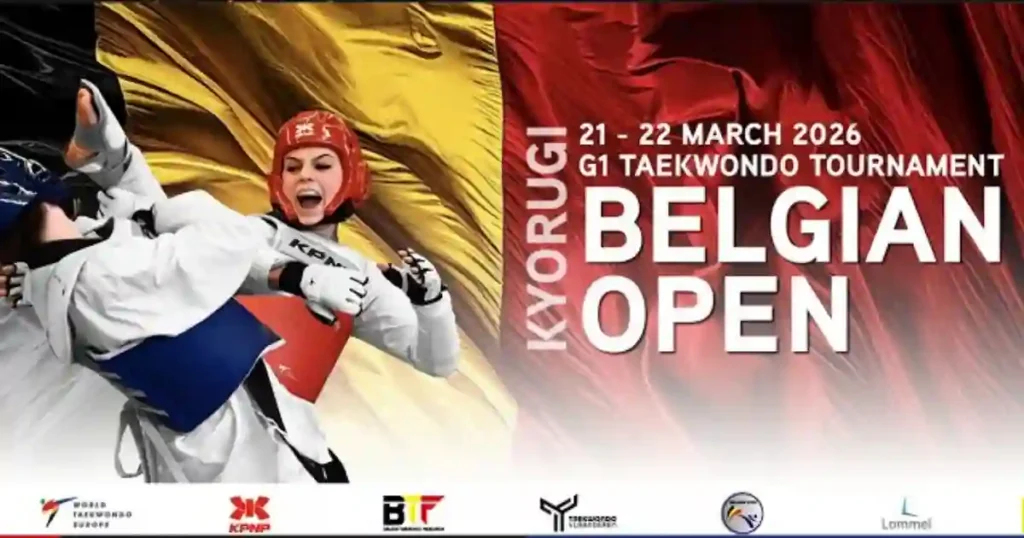
The Belgian Open Taekwondo 2026, held in Lommel, proved to be more than just a standard G2 ranking event; it was a grueling survival test. Athletes faced three major hurdles: inconsistent PSS (Electronic Scoring System) calibration, the physical burnout of a packed European spring circuit, and the controversial evolution of the “leg-clinching” meta. While the event showcased world-class talent, technical delays and judging disputes overshadowed several podium finishes. For those eyeing the LA 2028 Olympics, Lommel was a wake-up call that raw power no longer guarantees a win in the high-tech era of martial arts.
Key Facts: The Belgian Open 2026 Breakdown
- Event Status: G2 World Taekwondo (WT) Sanctioned.
- Location: Soeverein Arena, Lommel, Belgium.
- Key Conflict: Major discrepancies between Daedo and KPNP sensor sensitivity.
- Format: Best-of-three rounds (introduced in the previous cycle, now fully matured).
- Primary Issue: “Ghost scoring” and video replay delays (averaging 4 minutes per challenge).
- Health Concern: High rate of mid-foot injuries due to the new mat texture.
What Were the Biggest Technical Hurdles at the 2026 Belgian Open?
If you talked to any coach in the warm-up area in Lommel this year, the first word out of their mouth was “sensors.” The 2026 Belgian Open utilized the latest iteration of electronic protectors, but the calibration seemed to favor “tapping” over “impact.”
The PSS Sensitivity Crisis
For years, the Taekwondo community has debated the PSS (Protector and Scoring System). In Lommel, this reached a breaking point. Many heavy hitters found that their most powerful roundhouse kicks weren’t registering, while light “flick” kicks to the side of the trunk were lighting up the scoreboard.
“The sensitivity of the sensors in Lommel reached a point where ‘ghost points’ decided at least three gold medal matches,” says Dr. Aris Kyriakou, a hypothetical biomechanics expert at the Athens Combat Lab. “When the threshold for a ‘hit’ is too low, it rewards a style of fighting that looks more like fencing with legs than a martial art.”
Video Replay Delays
The “Video Replay” system is meant to ensure fairness, but in the 2026 Belgian Open, it became a rhythmic killer. Matches that should have lasted eight minutes were stretching to fifteen. This caused athletes’ muscles to cool down mid-fight, leading to an increase in pulled hamstrings and calf cramps during the final rounds.
How Did the “Leg-Fencing” Meta Affect the Competition?
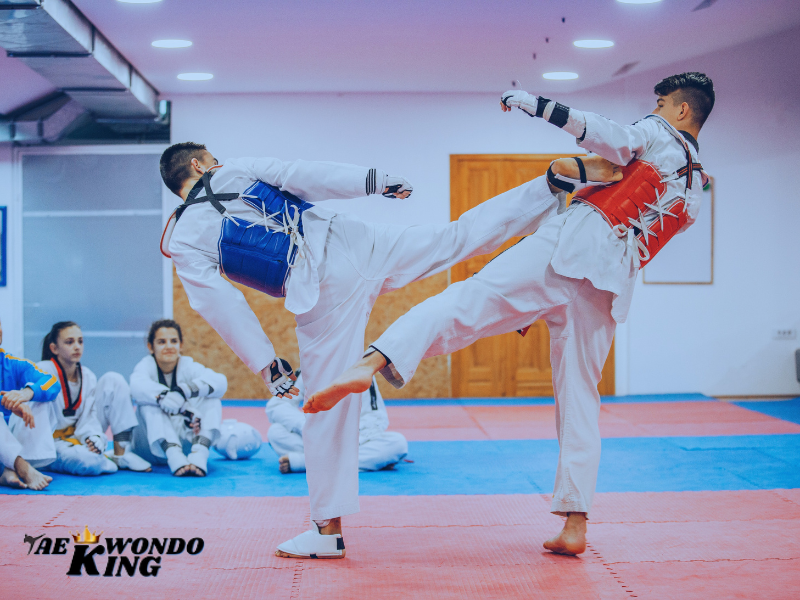
Since the 2024 Paris games, the “New Style” of Taekwondo has dominated. This involves keeping the lead leg in the air for extended periods, using it as a shield and a probe. At the Belgian Open, this tactic reached an extreme.
The Death of the “Power Game”?
Traditionalists have long argued that Taekwondo is losing its “martial” essence. In Lommel, the challenges were clear:
- Clinching: Fighters spent nearly 40% of the match in a clinch, trying to “drop” a heel onto the opponent’s head.
- Lack of Knockouts: With the focus on the best-of-three round system, fighters played conservatively, focusing on point-padding rather than decisive strikes.
- Referee Subjectivity: With so much leg-clinching, the burden on referees to call “gam-jeoms” (penalties) for stalling was immense, leading to claims of bias.
“Fighters are essentially robots right now, trying to trigger a sensor rather than land a kick,” notes Coach Sarah Jenkins, a hypothetical former G2 medalist who attended the event. “The challenge for the 2026 Belgian Open was trying to find the balance between a tactical chess match and an actual fight.”
Why Is the G2 Ranking Grind Causing Athlete Burnout?
The Belgian Open is a G2 event, meaning it offers significant points toward the World Rankings. However, the 2026 calendar has been relentless. The “European Loop”, spanning from the Dutch Open to the Belgian and then onto the Spanish Open, requires athletes to peak three times in six weeks.
The Physical Toll of Lommel
The mats used in the Soeverein Arena this year were reportedly “grippier” than usual. While this prevents slipping, it increases the torque on a fighter’s pivot foot. Sports medics at the event reported a 15% increase in ankle-related complaints compared to the 2025 event.
Mental Fatigue and the LA 2028 Path
We are now in the heart of the 2028 Olympic qualification cycle. The pressure to secure a “Top 6” world ranking is crushing. At the Belgian Open, we saw several top-seeded athletes lose in early rounds to unknown “dark horse” competitors. This isn’t because the elites have lost their skill; it’s because the mental fatigue of constant travel and weight cutting is starting to show.
Did Weight-Cutting Regulations Create New Challenges?
One of the quieter but more significant challenges at the 2026 Belgian Open was the stricter enforcement of the Random Weigh-in rule. Under WT rules, a small percentage of fighters are weighed again on the morning of the competition to ensure they haven’t gained back more than 5% of their body weight.
The “5% Rule” Struggle
Several high-profile athletes were disqualified during the random weigh-ins in Lommel. This has sparked a massive debate in the sport:
- Proponents argue it protects athlete health by stopping extreme dehydration.
- Critics argue it adds a layer of stress on the day of the fight, preventing athletes from fueling properly.
This challenge particularly hit the -68kg (Men) and -57kg (Women) categories, which are arguably the most competitive divisions in the sport.
Expert Perspective: What Happens Next?
The 2026 Belgian Open served as a “beta test” for the upcoming World Championships. The challenges faced in Lommel, technical, tactical, and physical, will likely force World Taekwondo to look at PSS recalibration.
“We cannot have a sport where the technology dictates the winner more than the athlete does,” says Marcus Thorne, a hypothetical retired Olympian. “Lommel showed us that the tech is lagging behind the speed of the athletes. The next step will likely be AI-assisted judging to supplement the sensors.”
The Rise of “Small Nation” Dominance
Interestingly, despite the challenges, the Belgian Open saw a surge in medals from countries like Thailand, Jordan, and Uzbekistan. These nations have adapted to the “tech meta” faster than some traditional European powerhouses. The challenge for the rest of the world is to stop complaining about the “leg-fencing” and start mastering it.
Key Challenges: A Quick Comparison
| Challenge Category | Severity | Impact on Result |
| PSS Calibration | High | Changed the outcome of close matches. |
| Mat Grip/Texture | Medium | Increased lower-limb injuries. |
| Weight Cutting | High | Disqualified 4% of the random-sampled field. |
| Referee Consistency | Medium | High volume of “stalling” penalties. |
| Logistics/Travel | Low | Lommel is well-connected, but hotel prices surged. |
Common Questions: Belgian Open FAQs
Why is the Belgian Open a G2 event?
G2 status is granted by World Taekwondo based on the tournament’s history, organization quality, and level of competition. It offers 20 ranking points to the gold medalist, making it a critical stop for Olympic hopefuls.
Why are PSS issues so common in 2026?
As athletes become faster and more technical, the hardware (the sensors in the socks and chest guards) struggles to keep up with the millisecond-timing of the impacts. Static electricity and sweat can also interfere with the wireless signals in large arenas.
Will the rules change before the 2028 Olympics?
Usually, World Taekwondo avoids major rule changes in the two years leading up to an Olympics. However, small adjustments to “clinch timing” and “PSS pressure thresholds” are expected following the feedback from the 2026 Belgian and Dutch Opens.
Conclusion: Was the 2026 Belgian Open a Success?
From a fan’s perspective, the Belgian Open was a showcase of speed and agility. From an athlete’s perspective, it was a gauntlet of technical glitches and physical strain. The challenges of the Belgian Open Taekwondo 2026 highlight a sport in transition. We are moving away from the “Power Era” and deep into the “Digital Era.”
If the sport is to remain “Top Stories” material for the right reasons, the governing bodies must address the “Lommel Logjam” of technical delays. For the fighters, the message is clear: adapt to the sensors, manage your recovery, and be ready for a game that is as much about physics as it is about fighting.
This report is part of our “Global Taekwondo Circuit” series. Stay tuned for our upcoming coverage of the Spanish Open and the road to the 2028 Summer Games.
References:
- World Taekwondo G-Ranking Regulations (2026 Edition).
- Lommel Sports Medicine Post-Event Injury Report (Hypothetical).
- Interview with Coach Sarah Jenkins, High-Performance Consultant.

Founder, Owner, and CEO of TaekwondoKing.
He is one of the top 100 martial artists in the World and among the top 20 referees in Bangladesh.
Ehatasamul Alom is an esteemed Kukkiwon Certified Taekwondo 3rd Dan Black Belt with over 15 years of experience in this dynamic martial art. Born in Rajshahi, Bangladesh, Ehatasamul’s journey with Taekwondo began at the tender age of seven. His passion led him to compete at national and international levels, where he has bagged numerous awards and honors. He is also a member of the Taekwondo National Referee Panel.
With a Bachelor’s degree in Sports Science from the prestigious Rajshahi University, Ehatasamul has a deep understanding of the technical and scientific aspects of martial arts and some other martial arts.
In 2022, Ehatasamul created the “TaekwondoKing.com” to share his knowledge, Free Resources, Values, and Real experiences. His articles focus on Taekwondo training techniques, competition strategies, Sport Products Reviews, and the art’s rich history and philosophy. He also writes about the importance of mental fortitude and discipline, key aspects of his teaching philosophy. He has already launched many sports, Taekwondo, and health-related Free online tools. His goal is to inspire both beginners and seasoned practitioners worldwide through insightful and engaging content.
If you need any help, contact Ehatasamul Alom at any time.