It is a cold Tuesday evening in a sports hall in Liverpool. One half of the class stands still. They are drilling patterns with total focus. The other half is bouncing in heavy chest guards. They are already sweating and out of breath. I remember feeling so torn between these two worlds. You might wonder which side deserves more of your time. This guide looks at poomsae vs sparring training to help you decide. We will see what each path builds. We will also look at how to balance both without feeling burnt out.
What Poomsae and Sparring Training Actually Mean
They are often taught in the same room. But they train very different skills and mindsets.
What Poomsae Training Develops
Poomsae is about precision, balance, and control. You learn to move with perfect posture. It tests your memory and how you link moves together. You also learn to stay calm when everyone is watching you. It builds a strong technical base that lasts for years.
What Sparring Training Develops
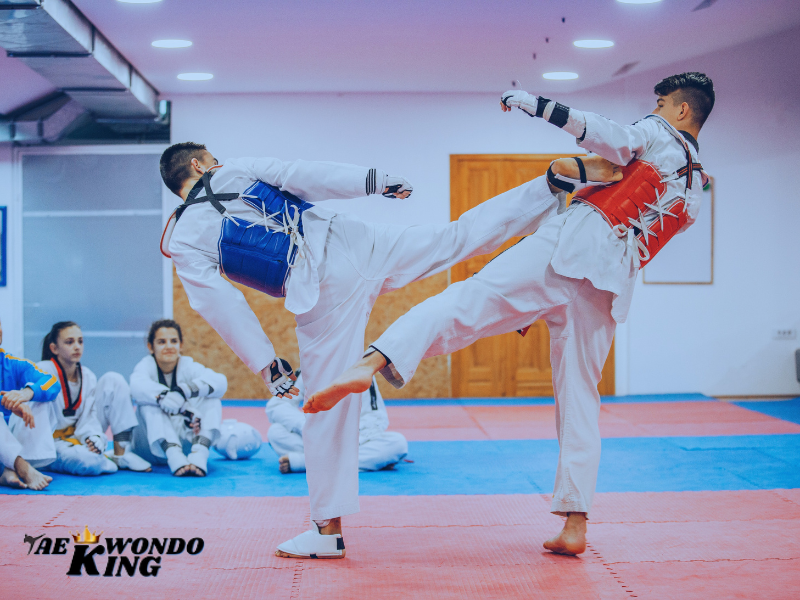
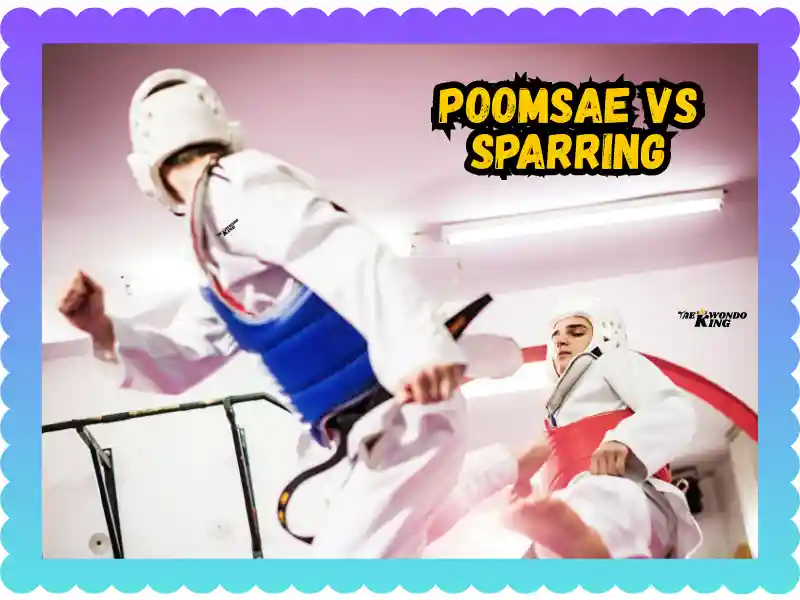
Sparring is all about timing and reaction speed. You learn how to manage distance against a moving target. It teaches you to be adaptable under pressure. Your fitness and resilience go up quickly. It forces you to make fast decisions in the middle of chaos.

Poomsae vs Sparring: Core Training Differences
Same uniform. Same belt. But the demands on your mind and body are worlds apart.
Structure vs Chaos
Poomsae uses fixed patterns. You know exactly what move comes next. It is predictable. Sparring is the opposite. It is full of stress and surprises. You never know what your opponent will do. One is your comfort zone; the other is a test of your nerves.
Internal Focus vs External Focus
In poomsae, you look inward. You feel your own body and correct your own stance. In sparring, your eyes are on the other person. You have to read their movement and react instantly. It is a shift from silence to the noise of impact.
Physical Benefits of Poomsae vs Sparring Training
Your body adapts differently depending on what you practise most.
Strength, Balance, and Mobility from Poomsae
Patterns build great lower body endurance. You learn to control your joints during slow moves. It builds core stability like nothing else. You develop a type of slow power that makes your kicks look very clean.
Cardiovascular and Explosive Gains from Sparring
Sparring is a high-energy workout. It uses your fast-twitch muscles for explosive kicks. You learn how to recover while you are still moving. It makes your body very efficient at using energy when you are tired.
Mental Skills Built by Poomsae vs Sparring
This is where many students in the UK feel torn between the two.
Mental Discipline from Poomsae
You need a lot of patience to get a pattern right. It teaches you to focus in a quiet room. You learn to perform alone without any applause. This builds a deep sense of perfection and self-discipline.
Mental Toughness from Sparring
Sparring helps you cope with fear. You learn to think clearly even when you are out of breath. It teaches you how to handle physical contact. You learn to reset your mind quickly after you make a mistake or lose a point.
Which Is Better for Beginners in the UK?
Most beginners quietly worry they are training the “wrong” thing early on.
Why Poomsae Helps Beginners Set Foundations
It is a much safer way to start. You learn how to do basic techniques properly before you ever hit a person. This builds confidence. It helps you understand the structure of Taekwondo without the fear of getting kicked.
Why Sparring Keeps Beginners Engaged
Sparring is fun and full of adrenaline. You feel like you are progressing faster because you can see your kicks landing. It is also great for social bonding with your club mates. Your fitness will improve very quickly in these sessions.
Common Mistakes When Choosing Poomsae or Sparring
Most mistakes come from choosing only one and ignoring the other.
Over-Focusing on Sparring Too Early
If you only spar, your technique can become sloppy. You might have poor balance and stop getting better. This is when injuries start to creep in. You need the “polish” that comes from pattern work to stay sharp.
Avoiding Sparring for Too Long
If you wait too long to spar, you might develop a fear of contact. Your distance awareness will be poor. This can lead to a big shock during your first grading. It creates a gap in your confidence that is hard to fill later.
British Expert Advice on Poomsae vs Sparring
UK coaches see this debate every single week in their dojangs.
Insight from a UK Taekwondo Coach
I asked a senior coach about the best way to progress in a local club.
“Students who progress fastest don’t pick sides. They let poomsae clean their technique and sparring test it under pressure. If you want to be a complete martial artist, you need both the calm and the storm.”
— Master Simon Reynolds, WT Coach & Referee, Birmingham
Poomsae vs Sparring Training Compared
After years of club sessions, I have seen these contrasts stay the same.
| Aspect | Poomsae Training | Sparring Training |
| Focus | Precision & form | Reaction & timing |
| Environment | Quiet & controlled | Fast & unpredictable |
| Fitness | Muscular endurance | High cardio demand |
| Stress | Performance pressure | Physical pressure |
| Scoring | Accuracy & presentation | Points & tactics |
How UK Grading and Competition Treat Both
This part often surprises new students when they go for their first belt.
Grading Expectations in UK Clubs
In most UK clubs, poomsae is weighted very heavily. You must show you know your forms to pass. Sparring is usually seen as a demonstration of control. The examiners want to see that you can move, not that you can dominate.
Competition Pathways
You can choose to specialise later on. Some people only enter poomsae competitions. Others only want to do sparring tournaments. But for your general training, your instructor will likely ask you to do both.
Training Tools Used in Poomsae vs Sparring
Different goals need different bits of kit to help you improve.
Tools Commonly Used in Poomsae Training
- Mirrors: To check your hand and foot height.
- Floor markers: To keep your lines straight.
- Resistance bands: To build slow, controlled strength.
- Video playback: To see the small flaws you can’t feel.
Tools Commonly Used in Sparring Training
- Hogu and head guards: For safety during contact.
- Kick paddles: To work on speed and accuracy.
- Reaction lights: To improve your “twitch” speed.
- Interval timers: To simulate the rounds of a real match.
How to Balance Poomsae and Sparring Each Week
Balance does not mean you have to spend the exact same amount of time on each.
Example Weekly Split for UK Students
- Beginners: 70% Poomsae / 30% Sparring. Focus on the basics first.
- Colour Belts: 50% Poomsae / 50% Sparring. Start to test your skills more.
- Competitive Athletes: 20% Poomsae / 80% Sparring (or the other way around).
Listening to Fatigue and Motivation
Some weeks, poomsae might feel mentally heavy. Other weeks, sparring might feel physically draining. It is okay to adjust your focus. Do not feel guilty if you need a “quiet” session of patterns to recover from a hard week of fighting.
Real-Life Training Scenarios UK Students Recognise
These moments will feel very familiar if you have spent time in a British dojang.
Cold Winter Evenings and Quiet Poomsae Sessions
The hall is empty and the floor is freezing. You hear the echo of a single “kihap.” These slow, focused reps are when you really learn the soul of the sport. It feels peaceful and disciplined.
Loud Sparring Nights Before Competitions
The room is full of shouting coaches and heavy breathing. You can hear the thud of shin guards hitting pads. These nights are intense and sweaty. They build the bond between you and your sparring partners.
Poomsae vs Sparring , Which Should You Prioritise?
The honest answer depends on what you want to get out of the sport.
Based on Goals
If you want to pass your gradings, focus on your forms. If you want fitness and fast weight loss, sparring is better. For competition, you will need to specialise in one. For confidence, a mix of both is always best.
Based on Personality
Are you a calm person who likes details? You might love poomsae. Are you an instinctive mover who likes a challenge? Sparring might be your favourite. Most students find that they enjoy one more but need the other to grow.
Poomsae vs. Sparring: The Yin and Yang of 2026 Taekwondo
In the modern 2026 training landscape, students often feel pressured to choose a “path”, becoming a specialized Poomsae (Forms) athlete or a Kyorugi (Sparring) competitor. However, true mastery requires understanding how these two pillars support each other.
1. The Core Mechanical Difference
A common question in the dojang is: “Why do we kick differently in forms than we do on the pads?”
- Poomsae (Control): You are fighting an imaginary opponent. Without a target to absorb your impact, you must use your antagonist muscles to “stick” the kick. This builds elite stability and skeletal alignment.
- Sparring (Power): You are kicking through a target. You rely on the impact of the Hogu (body protector) or shield to help you recover your balance. This is about explosive speed and anaerobic capacity.[Image: Comparison of Side Kick alignment in Poomsae vs. the ‘pushing’ hip motion of Sparring]
2. The 2026 Training Split
For a well-rounded 2026 practitioner, we recommend a 60/40 training split depending on your current goals:
- Grading Focus: 60% Poomsae / 40% Sparring. Precision and terminology are the priorities for belt advancement.
- Tournament Focus: 40% Poomsae / 60% Sparring. Conditioning and clinch-work take precedence.
3. Injury Prevention & Biomechanics
| Feature | Poomsae Training | Sparring Training |
| Common Injury | Pelvis/Hip Sprains | Ankle/Knee Fractures |
| Focus | Technical Accuracy | Reactive Timing |
| Energy System | Aerobic/Focus | Anaerobic/Explosive |
4. Why You Need Both
Students who ignore Poomsae often lack the foundational balance needed for high-level spinning kicks in 2026 competition. Conversely, students who ignore sparring often develop “stiff” movements that lack the fluidity required for higher-level black belt forms like Koryo or Keumgang.
Expert Insight: In 2026, Freestyle Poomsae has bridged the gap, requiring acrobatic kicks that demand the power of sparring and the grace of traditional forms. Training both isn’t just a tradition; it’s a competitive necessity.
When Poomsae and Sparring Finally Click Together
This is the best part of training. It is the moment when you realise they are not rivals.
Technique Carrying Over
You will notice your balance in sparring gets better because of your poomsae. Your kicks become cleaner, even when you are under pressure. You stop “flailing” and start moving with a real purpose.
Confidence Without Force
You start to feel less panic when someone attacks you. You have more control over your own body. This is when the true enjoyment of Taekwondo returns. You feel like a complete martial artist, ready for anything.
Thoughts on Poomsae vs Sparring Training
Poomsae and sparring are not enemies. They are like two sides of the same coin. One builds the engine, and the other tests it on the road. If you embrace both, you will find that your progress is much smoother. You will become a stronger, smarter, and more balanced student.
Final Recommendation
Do not feel you must choose one path too early in your journey. Use poomsae vs sparring training as two tools to build your skill. I suggest you spend a bit more time on patterns before your next grading. It will make your kicks look much sharper when you finally get to spar. You will feel proud of how much control you have on the mat.
FAQs
Poomsae training focuses on set patterns and form. Sparring training is live and reactive. One builds precision, the other builds timing and fight sense.
Both help in different ways. Poomsae teaches basics and balance first. Sparring adds movement and confidence once skills feel steady.
Yes, clean poomsae sharpens stance, blocks, and kicks. These basics carry into sparring. Good form often means faster, safer moves.
Not really. Sparring is fast and messy. Poomsae builds control and detail. Skipping forms can leave gaps in technique.
Sparring often burns more due to speed and constant motion. Poomsae is steadier but still tough. Mixing both gives a balanced workout.
Try two or three poomsae sessions and one or two sparring days. This keeps skills sharp. Adjust based on goals and fitness.
Gradings test poomsae and basics first. Competitions may focus on one style. Train both so you stay ready for any taekwondo path.

Founder, Owner, and CEO of TaekwondoKing.
He is one of the top 100 martial artists in the World and among the top 20 referees in Bangladesh.
Ehatasamul Alom is an esteemed Kukkiwon Certified Taekwondo 3rd Dan Black Belt with over 15 years of experience in this dynamic martial art. Born in Rajshahi, Bangladesh, Ehatasamul’s journey with Taekwondo began at the tender age of seven. His passion led him to compete at national and international levels, where he has bagged numerous awards and honors. He is also a member of the Taekwondo National Referee Panel.
With a Bachelor’s degree in Sports Science from the prestigious Rajshahi University, Ehatasamul has a deep understanding of the technical and scientific aspects of martial arts and some other martial arts.
In 2022, Ehatasamul created the “TaekwondoKing.com” to share his knowledge, Free Resources, Values, and Real experiences. His articles focus on Taekwondo training techniques, competition strategies, Sport Products Reviews, and the art’s rich history and philosophy. He also writes about the importance of mental fortitude and discipline, key aspects of his teaching philosophy. He has already launched many sports, Taekwondo, and health-related Free online tools. His goal is to inspire both beginners and seasoned practitioners worldwide through insightful and engaging content.
If you need any help, contact Ehatasamul Alom at any time.