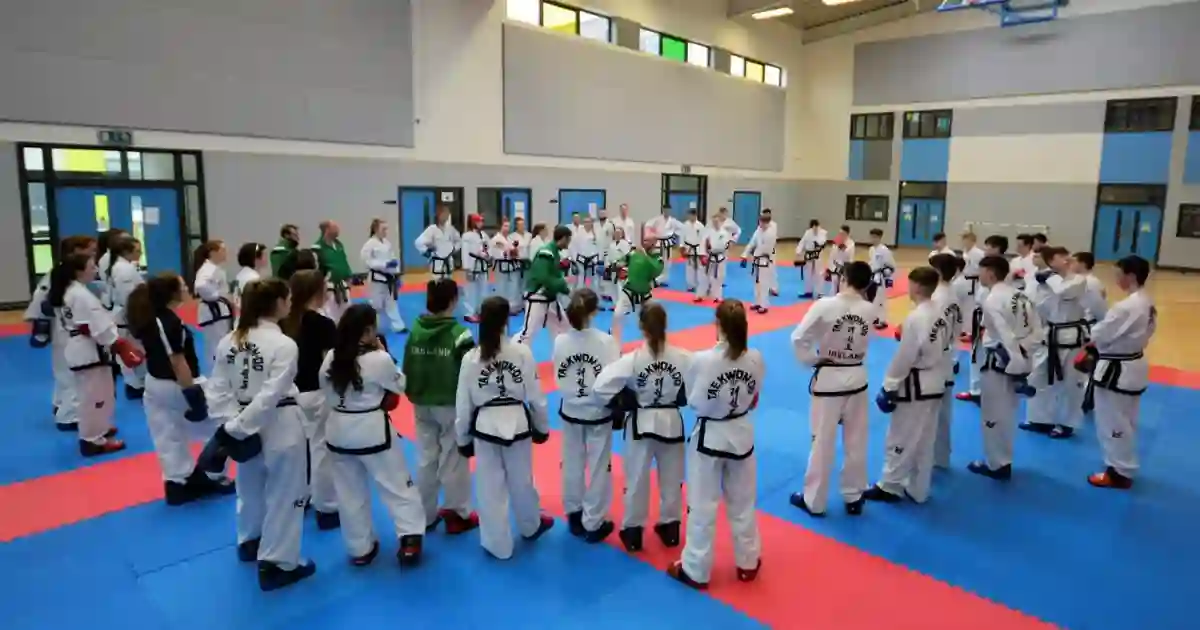
Thirty students. One coach. Five hands raised with questions at the exact same moment. Somewhere in the back, a belt has come loose, and two kids are practicing a kick that does not exist in any official curriculum, with total confidence. I once ran a Saturday class like this in a packed studio in Portland, Oregon, and learned fast that you turn around for five seconds and suddenly half the class has invented a new technique. Taekwondo coaching large classes efficiently is not about yelling louder or moving faster.
It comes down to better structure, smarter grouping, more repetitions, less standing around, safer partner work, and sharper feedback. This guide walks through exactly how to build that kind of class, drawing on USA Taekwondo’s own athlete centered development approach and its focus on age appropriate activities, engagement, games, drills, and quality coaching.
What Makes a Large Taekwondo Class Difficult to Coach?
Large classes create a simple math problem. One coach cannot watch every single student at the same time.
Too Many Students Need Attention at Once
A packed room brings constant questions, technique errors, behavior issues, equipment needs, safety concerns, and students learning at very different speeds, all competing for the same coach.
Different Skill Levels Create Chaos
Picture white belts learning Ap Chagi while green belts work combinations and black belts practice advanced movement in the same room. One drill will rarely fit everyone at once, a challenge that also shows up in the mixed group settings described in taekwondo for beginners.
Space Becomes a Coaching Issue
Dojang layout, student spacing, lines, boundaries, equipment zones, and entry and exit points all shape how smoothly a large class actually runs.
The Coach Becomes the Bottleneck
The pattern usually looks like this: coach talks, students wait, coach demonstrates, students wait again. The fix is designing the class so students stay moving and learning while the coach observes.
How Many Students Can One Taekwondo Coach Manage?
There is no single universal class size number that works for every dojang.
Class Size Depends on the Activity
Warm up, basic technique, Poomsae, partner drills, Kyorugi, weapons work, and contact activities all carry very different supervision needs, a distinction that matters just as much in taekwondo kyorugi rules wt as it does in a casual practice session.
Age Changes the Equation
A group of 25 teenagers is nothing like a group of 25 six year olds. Attention span, safety awareness, communication, independence, and motor skills all shift the coaching demand.
Skill Level Changes the Equation
A beginner class, a mixed level class, and an advanced competition class each need a different coaching rhythm.
Use Student-to-Coach Ratio as a Planning Metric
Rather than treating one ratio as universally safe, track the number of students, number of coaches, number of assistant coaches, class activity, contact level, and student age together.
Table 1: Large Taekwondo Class Planning Matrix
Class size is only one part of the problem. A group of 30 students doing basic footwork looks nothing like 30 students doing live sparring. Use activity, age, skill level, and available coaches together when planning.
| Class Situation | Difficulty | Coaching Need | Best Structure |
|---|---|---|---|
| 20 beginners | Moderate | High | Stations and demonstrations |
| 30 mixed belts | High | High | Skill groups |
| 25 children | High | Very high | Short drills and assistants |
| 30 Poomsae students | Moderate | Medium to high | Small groups |
| 30 Kyorugi students | Very high | Very high | Stations and strict rotation |
| 40 plus students | Very high | Very high | Multiple coaches and groups |
Build a Large Taekwondo Class Around Structure
A large class should feel organized without feeling stiff. Students should know what happens next before you ever have to shout it across the room.
Use a Predictable Class Format
A reliable structure runs through arrival and setup, warm up, skill focus, demonstration, group practice, partner or station drills, application, review, cool down, and closing instructions.
Use the Same Transition Signals
Commands like Charyeot and Kyeong Rye, a clap pattern, a whistle, a timer sound, or a visual cue all work well as long as they stay consistent. Use Korean commands naturally, but take time to teach beginners exactly what they mean.
Keep Instructions Short
Skip long instructions like explaining that everyone should move toward the left side while keeping distance. Instead, say “blue line, two steps apart, go.” Short and clear beats long and polite every time.
Demonstrate Before Explaining Too Much
Follow a simple pattern: show, explain, practice, correct, instead of opening with a five minute speech.
A basic set of floor cones, like these on Amazon, makes marking these transition lines fast and visual for students of any age.
Divide Large Taekwondo Classes Into Small Groups
Grouping is one of the most powerful tools available for large class coaching.
Group by Belt Level
A common split runs white and yellow belts together, green and blue belts together, and red and black belts together.
Group by Skill Level
This often works better than strict belt rank when students inside the same belt have very different real world experience.
Group by Training Goal
Groups can also form around technique, Poomsae, kicking, fitness, or sparring focus for the day.
Give Each Group a Clear Job
Every group needs to know what to do, how many repetitions to complete, how long they have, where to stand, and what success actually looks like.
Use Color or Number Groups
Simple labels like Red Team, Blue Team, Green Team, or Group 1 through 4 make transitions far faster than trying to call out individual names.
Use Stations to Coach More Students at Once
Station training lets the coach move around the room instead of becoming a human traffic controller.
Station 1: Technique
This station can cover Ap Chagi, Dollyo Chagi, or punch combinations, the same core movements covered in taekwondo moves.
Station 2: Footwork
Focus this station on stance changes, forward and backward movement, and angle changes.
Station 3: Poomsae
Keep this station centered on a small sequence, direction, stance, and hand technique.
Station 4: Conditioning
Fill this station with squats, planks, and controlled agility drills.
Station 5: Coach Feedback
Keep one station close to the instructor for detailed, hands on correction.
Rotate Every Few Minutes
Use a timer, whistle, bell, or visual countdown to keep rotations consistent and predictable.
A simple interval timer, available here on Amazon, takes the guesswork out of station rotations and protects your voice at the same time.
How to Teach Technique Efficiently to a Large Group
The goal is not to give less coaching. It is making each explanation reach more people at once.
Use One Main Coaching Cue
For Ap Chagi, a cue like “knee up, extend, recoil” works better than a long paragraph, since three short cues stick far better than fifteen.
Demonstrate From Multiple Angles
Show the technique from the front, from the side, and once more in slow motion so every angle of the room can actually see it clearly.
Use a Student Demonstrator
Choosing a capable student to demonstrate saves time, gives the class a clear visual example, builds that student’s confidence, and creates a small leadership opportunity.
Teach One Common Error at a Time
If fifteen students share the same mistake, stop the whole group, fix that one error, and restart together instead of correcting fifteen people one by one.
How to Correct Many Students Without Stopping the Class
Large classes run best when correction happens while movement keeps going.
Use Whole-Group Corrections
A line like “everyone, check your back heel” followed by a quick restart fixes a shared issue in seconds.
Use Individual Corrections While Others Practice
Walk the room and drop short cues such as higher knee, relax, turn the hip, eyes forward, or again.
Use Positive Correction
Swap “that’s wrong” for something like “good start, now keep your supporting foot planted,” which keeps motivation high while still fixing the issue.
Use the “One Fix” Rule
Give one or two corrections at a time, since too many corrections at once can overload a beginner fast.
How to Manage Mixed-Level Taekwondo Classes
Mixed classes are common in smaller dojangs. The trick is sharing one theme while adjusting the difficulty.
Use One Technique With Three Levels
Take Dollyo Chagi as an example. Beginners work on chamber, extension, and recoil. Intermediate students add footwork, a target, and increased control. Advanced students layer in combinations, movement, and tactical setup.
Give Advanced Students a Challenge
Push advanced students with speed, accuracy, combination work, reaction drills, and timing challenges rather than letting them coast.
Do Not Make Advanced Students Become Unpaid Coaches
They can absolutely help out, but they should still get real training time of their own, a balance that matters for the long term growth described in most important things learning taekwondo.
How to Keep Children Engaged in Large Taekwondo Classes
A large children’s class can go from focused to fully feral in about eleven seconds.
Use Short Activity Blocks
Stick to 3 to 7 minute drills with frequent changes and clear goals to match young attention spans.
Turn Repetition Into a Game
Target accuracy challenges, balance games, reaction games, team relays, and technique point systems all turn plain repetition into something kids actually want to do.
Use Names
Calling a student by name restores attention faster than almost anything else in the room.
Avoid Long Lines
If 25 children are waiting in line for one kick pad, that is a queue, not a training drill, a lesson that fits the fast paced approach in ultimate guide to teaching kids taekwondo.
Follow Developmentally Appropriate Training
USA Taekwondo’s American Development Model emphasizes physical literacy, fun and engaging play, Taekwondo related games and drills, inclusion, and athlete centered development, the same philosophy behind which martial arts for kids.
How to Manage Large Kyorugi Classes Safely
Sparring deserves its own section, since it changes both the risk level and the organization required.
Divide by Appropriate Factors
Consider age, experience, size, skill, protective equipment, and coach availability before pairing anyone up.
Use Controlled Rounds
Technical rounds, footwork rounds, reaction rounds, limited contact drills, and situational sparring all keep intensity appropriate for the group.
Create Clear Sparring Zones
Assign one pair per zone, mark clear boundaries, set a waiting area, position the coach carefully, and keep emergency access open at all times.
Limit Simultaneous Sparring When Necessary
More students moving at once does not automatically mean better training, especially when supervision gets stretched thin.
Use Assistant Coaches
One assistant can monitor one or more zones while the lead coach observes the entire class, a structure that supports the safety standards in taekwondo safety and medical rules.
A set of hand target pads, found on Amazon here, works well for controlled rounds without adding full contact risk too early.
How to Run Large Poomsae Classes Efficiently
Poomsae depends on repetition, close observation, and precise correction.
Teach in Sections
Break the form into direction, stance, block, strike, and transition rather than trying to fix the whole pattern at once.
Use Small Performance Groups
Have Group A perform, Group B observe, and Group C practice slowly, then rotate through all three roles.
Use Video Feedback
Record short clips and review stance, timing, direction, balance, and technique together as a group.
Use One Correction Theme Per Round
Round one can focus on stance, round two on timing, round three on technique, and round four on overall presentation.
Use Assistant Coaches Without Losing Control
Assistant coaches can dramatically improve large classes once their roles are clearly defined.
Assign Specific Roles
One assistant can lead the beginner group, another the advanced group, and a third can manage equipment and safety, while the lead coach focuses on main teaching, observation, and correction.
Give Assistants a Brief Before Class
Five minutes of clear direction before class can prevent forty five minutes of confusion once it starts. Cover the goal, the drill, safety points, common errors, and rotation timing.
Avoid Multiple Coaches Giving Different Instructions
One lead coach sets the message, and assistants reinforce it rather than adding conflicting instructions.
Train Your Assistant Coaches
Teach assistants how to demonstrate, how to correct, how to speak to children, how to stop unsafe behavior, and when to bring something to the lead coach, a coaching pipeline that fits well with the path described in skilled taekwondo referee in 2024.
Table 2: Large-Class Coach Roles
A large class becomes far easier once everyone on the coaching team knows their lane. USA Taekwondo’s own coach development material emphasizes communication, teamwork, organization, technical knowledge, and understanding athletes, not just technical rank.
| Role | Main Job |
|---|---|
| Lead coach | Teach, observe, manage class |
| Assistant coach | Run assigned group |
| Junior assistant | Demonstrate and support |
| Safety coach | Watch spacing and risky activity |
| Equipment lead | Pads, targets, gear |
| Advanced student | Help with simple demonstrations |
How to Use the Dojang Space Efficiently
A good lesson can still fall apart if everyone gets packed into one corner of the room.
Create Permanent Training Zones
Set up a technique area, kicking area, Poomsae area, conditioning area, and sparring area so students always know where to go.
Use Floor Markings
Tape, lines, cones, or colored spots give students an instant visual reference without extra explanation.
Plan Movement Direction
Set clear traffic patterns so students never cross straight through an active drill.
Keep Equipment Ready
Prepare hogu, kick pads, targets, cones, a timer, and water access before class starts. Less searching means more actual training time.
Build a 60-Minute Large Taekwondo Class
Here is a ready made model you can adapt to your own dojang.
0 to 5 Minutes: Arrival and Setup
Line up, take attendance, check equipment, and share a quick goal for the day.
5 to 12 Minutes: Warm-Up
Cover movement, agility, balance, and coordination to get everyone ready.
12 to 20 Minutes: Main Skill
Demonstrate the skill, give a short explanation, then move into group practice.
20 to 40 Minutes: Stations
Run four or five stations covering the range of skills described earlier in this guide.
40 to 52 Minutes: Application
Use partner drills, Poomsae performance, controlled sparring, or a skill challenge to apply what was practiced.
52 to 57 Minutes: Review
Ask what the class learned, what the main cue was, and what mistake to avoid next time.
57 to 60 Minutes: Close
Finish with stretching, a bow, and a quick reminder about the next class.
Table 3: 60-Minute Large-Class Template
The exact minutes can shift based on age and goal. The core idea is reducing dead time and keeping students moving, learning, or receiving feedback for most of the session.
| Time | Activity | Coach Focus |
|---|---|---|
| 0 to 5 | Setup | Attendance and safety |
| 5 to 12 | Warm-up | Movement quality |
| 12 to 20 | Skill demo | Main teaching |
| 20 to 40 | Stations | Observation |
| 40 to 52 | Application | Correction |
| 52 to 57 | Review | Learning check |
| 57 to 60 | Close | Recovery and next step |
How to Keep Large Taekwondo Classes Safe
Efficiency should never come before safety.
Establish Three Non-Negotiable Rules
Simple rules work best, such as stop means stop, stay inside your zone, and no technique until the coach says go.
Teach Equipment Rules
Cover how to carry pads, where to place equipment, how to wear protective gear, and when to stop using it.
Use a Stop Signal
Every student should know exactly what the stop signal means and react to it instantly.
Watch High-Risk Activities Closely
Pay extra attention to contact drills, sparring, flying techniques, fast partner work, and advanced kicks, the same activities flagged in most common injuries in taekwondo.
Make Safety Part of the Lesson
Treat safety as a real coaching skill rather than a boring announcement tacked onto the start of class.
USA Expert Advice on Coaching Large Groups
This section grounds the guide in real, documented expertise from within the sport.
Nikki Oliver: Development and Athlete-Centered Coaching
Nikki Oliver is USA Taekwondo’s Development Teams Manager, appointed to the newly created role in March 2026 to oversee development programs across both able bodied and para disciplines. She brings a rare mix of elite competition experience and proven coaching credentials, including becoming the first American woman to coach Taekwondo at an Olympic Games at Paris 2024. On accepting the role, Oliver said she felt motivated by the opportunity and excited to work alongside people committed to “building excellence in this sport at the developmental level.” That statement fits directly into large class coaching. Development is not about forcing everyone through the same motion at the same pace. It is about building a structure where athletes at every stage keep progressing.
USA Taekwondo’s Coaching Criteria
USA Taekwondo’s published coaching criteria highlight technical acumen, communication, motivation, organization, teamwork, knowledge of athletes, tactical planning, and the ability to evaluate athletes quickly, a standard that lines up closely with taekwondo referee rules and the broader coaching expectations across the sport.
The Big Lesson for Large Classes
A strong large group coach needs to observe, prioritize, communicate, organize, and adjust. That combination matters far more than simply talking louder.
How to Give Individual Attention in a Large Class
Large does not have to mean anonymous.
Learn Names
Use student names during corrections and rotate who receives personal feedback each class.
Use Micro-Feedback
Give each student one useful, specific correction rather than trying to fix everything at once.
Keep a Student Notes System
Track each student’s strength, weakness, current goal, attendance, and next planned correction.
Rotate Your Attention
Avoid spending every class with the loudest student, the strongest student, or the one who asks the most questions. Quiet students need real coaching too, a point that connects to the confidence building work in how taekwondo build self confidence.
Use Technology to Coach Large Taekwondo Classes Better
This section covers practical tools rather than another generic list of tips.
Digital Class Planner
Track class size, skill levels, lesson goals, equipment, groups, and rotation timing in one place.
Digital Timer
Set drill time, rotation time, rest periods, and round length with a single reliable tool.
Attendance Tracker
Track attendance, late arrivals, progress, and belt level over time.
Video Feedback
Record short clips instead of filming an entire sixty minute class, which keeps review time manageable.
Progress Dashboard
Track individual and group progress side by side to spot patterns early.
A reliable stopwatch or coaching timer, like this one on Amazon, covers most of these timing needs without any complicated setup.
Build a Large Taekwondo Class Planner Tool
This section turns the guide into something a coach can actually put to use immediately.
Tool Inputs
A useful planner should collect number of students, number of coaches, student ages, belt distribution, whether the focus is Kyorugi, Poomsae, or basics, class duration, dojang size, available equipment, main skill, and training goal.
Tool Outputs
From those inputs, the tool should generate group assignments, a station layout, a rotation schedule, a drill sequence, an equipment list, coach assignments, a safety checklist, and a timing plan.
Example
For 32 students, 2 coaches, 60 minutes, mixed belts, 8 kick pads, and a main goal of Dollyo Chagi, the output might look like 4 groups, 4 stations, 8 minute rotations, one coach floating between stations, one coach focused on technique correction, and a final application round to close.
Add a Class Capacity Warning
The tool can flag that a given activity may need more coaches, more space, or smaller groups. Keep this framed as a planning warning rather than a claim of a universal safety limit.
Common Large-Class Coaching Mistakes
Watch for talking too much, making the whole class wait for one student, using one drill for every skill level, creating long lines, changing drills without explaining the rotation, trying to correct every single student, and letting advanced students become unsupervised coaches.
How to Coach Large Classes Without Burning Yourself Out
Large classes can exhaust the instructor just as much as the students.
Prepare the Lesson Before Class
Write out the goal, main drill, groups, equipment, rotations, and safety points ahead of time.
Use Repeatable Lesson Templates
There is no need to reinvent the entire lesson plan every single Tuesday.
Delegate
Give assistant coaches real responsibilities rather than vague instructions to just help out.
Protect Your Voice
Lean on visual cues, hand signals, a timer, and demonstrations. You do not need to shout Charyeot at stadium announcer volume every ninety seconds.
Review After Class
Ask where students waited, where confusion happened, which drill worked well, which station struggled, and which students got little individual feedback that day.
A Practical Large Taekwondo Class Checklist
Before class, confirm the lesson goal is chosen, groups are planned, equipment is ready, assistant roles are assigned, safety points are selected, and the timer is set.
During class, keep instructions short, students moving, groups clear, the coach circulating, safety monitored, and individual feedback flowing.
After class, record attendance, note progress, identify problems, and adjust the next lesson based on what you saw.
Frequently Asked Questions
How do you teach Taekwondo to a large group?
Lean on structured groups, stations, short instructions, clear demonstrations, and well briefed assistant coaches.
How many students can one Taekwondo coach teach?
There is no single universal number. Activity, age, skill level, space, contact level, and available assistants all shape the real answer.
How do you keep a large Taekwondo class under control?
Use clear signals, predictable routines, defined zones, short drills, and consistent rules applied every single class.
How do you teach beginners and advanced students together?
Share one theme across the whole class, then adjust the difficulty level for each group within that theme.
How do you run sparring with a large group?
Use controlled zones, suitable pairings, clear rules, proper protective equipment, and enough supervision to cover every zone.
How can I correct many students at once?
Use whole group corrections for shared mistakes and short individual micro-feedback for unique problems.
Are stations good for Taekwondo classes?
Yes, as long as each station has a clear task, a set time, defined space, and its own safety rule.
How can assistant coaches help?
Give them defined groups and specific duties rather than a vague instruction to simply help around the room.
How do I keep kids engaged in a large Taekwondo class?
Use short activity blocks, games, challenges, names, constant movement, and age appropriate drills throughout class.
How can technology help with large Taekwondo classes?
Planners, timers, attendance systems, video feedback, and progress trackers all reduce the mental load on the coach.
Final Recommendation
After years of running full dojang floors packed with mixed belts and mixed ages, I can tell you that coaching large Taekwondo classes efficiently comes down to structure, not volume. I plan my groups and stations before students ever walk in, I lean on trained assistants instead of trying to do everything myself, and I keep instructions short so students spend more time moving than listening. A large class can still deliver real individual attention if you rotate feedback fairly and track each student’s progress over time. Build your system once, refine it week by week, and your biggest class of the year will start to feel just as manageable as your smallest one.

Founder, Owner, and CEO of TaekwondoKing.
He is one of the top 100 martial artists in the World and among the top 20 referees in Bangladesh.
Ehatasamul Alom is an esteemed Kukkiwon Certified Taekwondo 3rd Dan Black Belt with over 15 years of experience in this dynamic martial art. Born in Rajshahi, Bangladesh, Ehatasamul’s journey with Taekwondo began at the tender age of seven. His passion led him to compete at national and international levels, where he has bagged numerous awards and honors. He is also a member of the Taekwondo National Referee Panel.
With a Bachelor’s degree in Sports Science from the prestigious Rajshahi University, Ehatasamul has a deep understanding of the technical and scientific aspects of martial arts and some other martial arts.
In 2022, Ehatasamul created the “TaekwondoKing.com” to share his knowledge, Free Resources, Values, and Real experiences. His articles focus on Taekwondo training techniques, competition strategies, Sport Products Reviews, and the art’s rich history and philosophy. He also writes about the importance of mental fortitude and discipline, key aspects of his teaching philosophy. He has already launched many sports, Taekwondo, and health-related Free online tools. His goal is to inspire both beginners and seasoned practitioners worldwide through insightful and engaging content.
If you need any help, contact Ehatasamul Alom at any time.