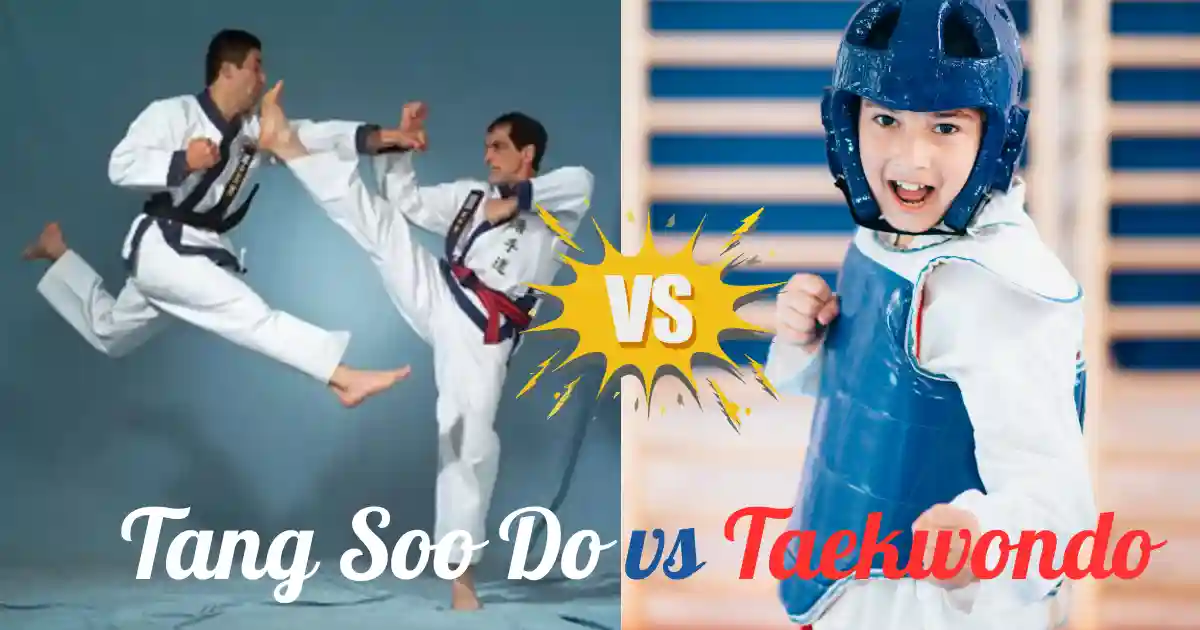
Two Korean martial arts. One nagging question. Which one is actually right for you. If you have searched for a Korean martial art, you have probably seen both Tang Soo Do and Taekwondo pop up side by side. At first glance they look similar. White uniforms. Colored belts. Plenty of kicks. But spend one Saturday morning watching both classes in a city like Denver, Colorado, and the differences become clear fast. One instructor joked, “our kicks may look like cousins, but our training personalities are very different.” He was not wrong. This guide breaks down the real differences in history, technique, sparring, and daily training, so you can pick the style that actually fits your goals.
Tang Soo Do vs Taekwondo at a Glance
Both martial arts share Korean roots, but they developed different training methods, competition formats, and technical emphasis over time.
Quick overview
Tang Soo Do leans traditional, with deep stances and a strong hand technique curriculum. Taekwondo, especially the World Taekwondo sport version, leans toward fast, dynamic kicking built for competition. Neither approach is wrong, they simply serve different training goals.
Shared Korean heritage
Both arts trace back to a shared postwar period in Korea, when several kwans, or schools, blended older fighting traditions with new training philosophies. This shared origin explains why a taekwondo or karate comparison often misses the mark when applied to Tang Soo Do, since the Korean roots run much deeper than a simple kicking style label suggests.
Major differences
The biggest gaps show up in competition rules, hand technique emphasis, and how each art balances tradition against sport performance. These differences echo similar debates seen in comparisons like taekwondo versus kung fu, where training philosophy matters as much as raw technique count.
Who each style suits best
Tang Soo Do often appeals to students drawn to traditional forms and self-defense depth. Taekwondo, particularly for those chasing Olympic level competition, suits students who want fast paced sparring and a clear competitive path. Neither answer is universal, since instructor quality shapes the experience more than the style name alone.
Table 1: Quick Comparison
People often ask which martial art is better. I usually ask what they want to achieve first. The answer changes everything.
| Category | Tang Soo Do | Taekwondo |
|---|---|---|
| Country of Origin | Korea | Korea |
| Main Focus | Traditional techniques and self-defense | Olympic sport and dynamic kicking |
| Competition | Limited | Extensive international competition |
| Kicking | High emphasis | Very high emphasis |
| Hand Techniques | Strong emphasis | Moderate emphasis (WT rules) |
| Forms | Hyung | Poomsae (WT) / Tul (ITF) |
History and Origins
Understanding each art’s history explains why their training methods differ today.
Origins of Tang Soo Do
Tang Soo Do developed in Korea during the mid twentieth century, drawing on older Korean fighting arts along with outside influence from neighboring traditions. This blend of influences gives Tang Soo Do a distinct flavor compared to purely native Korean systems.
Founder Hwang Kee
Hwang Kee founded Tang Soo Do and shaped much of its early curriculum around discipline, precise stances, and traditional forms. His personal training background across multiple systems shows up clearly in the breadth of technique Tang Soo Do still teaches today.
Moo Duk Kwan tradition
The Moo Duk Kwan school remains closely tied to Tang Soo Do’s identity, carrying forward many of its founding principles into modern schools.
Origins of Taekwondo
Taekwondo formed from a different path, eventually becoming one of the most widely practiced martial arts in the world and a recognized Olympic sport.
The Kwans
Several early Korean kwans contributed technique and philosophy to what eventually unified under the Taekwondo name, a history covered further in secrets of successful taekwondo programs still rooted in that founding era.
Development after the Korean War
Postwar Korea saw rapid growth in martial arts schools, with instructors refining technique and competition structure over the following decades.
Formation of Kukkiwon
Kukkiwon became the central authority for Taekwondo curriculum and rank certification, standardizing training across schools worldwide.
World Taekwondo (WT)
World Taekwondo governs the sport side of the art, including the official kyorugi sparring rules used at the Olympic level.
Philosophy and Training Goals
Both arts teach discipline and respect, but they emphasize different training outcomes.
Character development
Tang Soo Do often places heavy weight on character growth through repetition and precision in forms practice. This mirrors how taekwondo builds self discipline through similarly repetitive, structured training.
Respect and etiquette
Both arts share strong etiquette traditions, including bowing, uniform care, and respect toward instructors and training partners. New students in either art often notice this structure within their very first class.
Traditional values
Tang Soo Do schools frequently preserve older Korean values more explicitly than sport focused Taekwondo programs, a distinction that also shows up when comparing taekwondo to karate, another traditionally rooted striking art.
Competitive mindset
Taekwondo, especially through World Taekwondo tournaments, builds a stronger competitive mindset earlier in a student’s training.
Lifelong learning
Both arts frame training as a lifelong path, with belt progression marking growth rather than a finish line, a theme echoed in why taekwondo is the best martial art for many long term practitioners.
Technique Comparison
Although both systems use punches and kicks, their technical priorities often feel very different during training.
Kicking techniques
Taekwondo sparring rewards fast, high kicks, while Tang Soo Do keeps a broader traditional kicking curriculum that includes more grounded techniques. Practicing on a sturdy freestanding kick bag helps students in either style build power and accuracy outside regular class time.
Punches
Tang Soo Do dedicates more class time to hand techniques than modern WT style Taekwondo sparring, which limits punches under its scoring rules. A pair of training focus mitts is a simple way to sharpen hand speed and accuracy at home.
Blocks
Both arts teach a full range of blocks, though Tang Soo Do often practices them with a more traditional, deliberate structure, similar to the block heavy curriculum found in guides on top self-defense techniques.
Stances
Tang Soo Do stances tend to sit lower and wider, while Taekwondo stances stay more mobile to support quick footwork.
Footwork
Taekwondo footwork moves fast and light, built for the constant repositioning seen in taekwondo sparring.
Combinations
Tang Soo Do combinations often blend hand and foot techniques evenly, while Taekwondo combinations lean heavily toward kicks.
Speed versus power
Taekwondo sparring favors speed and scoring efficiency, while Tang Soo Do technique often emphasizes controlled power and precision.
Table 2: Technical Differences
I watched one Tang Soo Do class move slowly through forms with incredible precision. Next door, Taekwondo students were launching spinning kicks at lightning speed. Both rooms were impressive, just in different ways.
| Skill | Tang Soo Do | Taekwondo |
|---|---|---|
| Stances | Deeper | More mobile |
| Hand Techniques | Extensive | Less emphasized in WT sparring |
| Kicks | Traditional | Dynamic and sport-focused |
| Movement | Balanced | Fast and explosive |
| Footwork | Controlled | Highly active |
A well fitted pair of training kicking pads makes a noticeable difference when practicing either style’s kicking combinations at home between classes.
Forms: Hyung vs Poomsae
Forms help students develop technique, balance, timing, breathing, and body control.
What are Hyung?
Hyung are the traditional forms practiced in Tang Soo Do, built around fixed sequences that emphasize precision and stance depth, not unlike the structured progression found in taekwondo moves as students advance through belt ranks.
What are Poomsae?
Poomsae are the forms used in World Taekwondo poomsae competition, refined for both technical scoring and demonstration, governed formally by the taekwondo poomsae rules set by World Taekwondo.
Technical differences
Hyung tend to hold stances longer and emphasize grounded power, while Poomsae often move with sharper, quicker transitions built for competition judging.
Performance expectations
Poomsae competitors are judged on precision, speed, and presentation, while Hyung testing usually weighs depth of stance and control more heavily.
Belt progression requirements
Both systems require increasingly complex forms as students advance, though the specific list of forms and required detail varies by school and organization.
Sparring Differences
Rules shape how students train and which techniques they use most often.
Tang Soo Do sparring
Tang Soo Do sparring often allows a broader mix of hand and foot techniques compared to Olympic style Taekwondo rules, closer in spirit to how taekwondo compares against street fighting scenarios that reward a wider technique base.
WT Taekwondo sparring
WT sparring, governed by the official Taekwondo referee rules, rewards fast kicks to the body and head while limiting hand technique scoring.
ITF Taekwondo sparring
ITF style sparring differs from WT rules, often permitting a wider range of techniques and a different scoring structure, a distinction many new students miss when researching how to fight like a taekwondo master online.
Contact levels
Contact levels vary by school and organization, ranging from light control to full contact depending on the ruleset and student age group.
Scoring systems
Modern Taekwondo scoring often relies on electronic sensors built into gear, while Tang Soo Do competitions frequently use traditional point scoring by judges.
Safety equipment
Both arts require protective gear during sparring, and a properly fitted sparring gear set is one of the first investments most new students make.
Self-Defense Comparison
Both systems teach self-defense, but they approach practical situations differently.
Distance management
Taekwondo’s kicking range teaches strong distance control, while Tang Soo Do blends kicking range with closer hand technique work, echoing the layered approach found in martial art self-defense technique guides that stress range awareness.
Hand techniques
Tang Soo Do’s deeper hand technique curriculum gives students more tools for close range situations than sport focused Taekwondo sparring alone. A double end striking bag is a great way to sharpen hand speed and timing for either style.
Kicking strategy
Both arts use kicks strategically, though Taekwondo’s competition focus sharpens kicking speed and precision at range.
Escaping grabs
Neither art centers heavily on grappling, so students interested in self-defense against grabs often supplement training with additional grappling focused classes.
Practical applications
Both arts translate reasonably well to practical self-defense, though results depend heavily on instructor quality and how much sparring pressure testing happens in class.
Situational awareness
Good instructors in both styles teach situational awareness as the true first line of defense, well before any physical technique.
Table 3: Self-Defense Skills
One instructor smiled and said, “the best self-defense is noticing trouble early.” That lesson stuck with me longer than any kick combination.
| Situation | Tang Soo Do | Taekwondo |
|---|---|---|
| Basic striking | Excellent | Excellent |
| Long-range defense | Good | Excellent |
| Close-range techniques | Strong | Moderate |
| Sport application | Moderate | Excellent |
| Traditional techniques | Extensive | Moderate |
Belt Systems and Student Progression
Belt colors and testing requirements vary by organization and school.
Beginner ranks
Both arts start beginners with a white belt, moving through a series of colored ranks that mark growing skill and knowledge.
Intermediate belts
Intermediate belts in both systems typically add more complex forms, sparring skill, and technique combinations.
Black belt journey
Reaching black belt usually takes several years in either art, with the exact timeline depending on training frequency and school standards.
Testing requirements
Testing requirements often include forms, sparring, breaking, and technique demonstration, though the specific list varies between Tang Soo Do and Taekwondo organizations.
Promotion timelines
Promotion timelines depend on the individual school more than the art itself, so comparing two schools in the same style can show real differences.
Fitness Benefits
Both martial arts improve physical fitness, though the training experience feels different.
Cardiovascular endurance
Fast paced Taekwondo sparring drills build cardiovascular endurance quickly, a benefit well documented in guides on how taekwondo supercharges fitness.
Flexibility
Both arts improve flexibility, though the high kicking emphasis in Taekwondo often pushes hip and hamstring flexibility further, a topic covered in depth in our piece on why flexibility matters in taekwondo.
Coordination
Forms practice in both styles sharpens coordination between the upper and lower body.
Balance
Single leg kicking drills in both arts build strong balance over time, especially once students move past basic belt levels.
Functional strength
Repeated stances and kicks build functional strength through the legs, core, and hips in both training styles.
Mental focus
Both arts demand real mental focus during forms and sparring, which carries over into everyday discipline outside the dojang. A simple jump rope is a great supplemental tool for building the footwork rhythm both styles rely on.
Competition Opportunities
Competition is a major difference between these martial arts, especially internationally.
Olympic Taekwondo
Taekwondo has been an Olympic sport since 2000, giving WT style practitioners a clear path toward elite level competition.
WT tournaments
World Taekwondo runs a global tournament circuit, feeding into Olympic kyorugi rankings that top athletes chase throughout their careers.
ITF tournaments
ITF Taekwondo runs its own separate tournament structure, with different rules and scoring than the WT Olympic system.
Tang Soo Do competitions
Tang Soo Do competitions exist but on a smaller scale than Taekwondo’s international tournament circuit.
Forms competitions
Both arts hold dedicated forms competitions, judged on precision, power, and presentation rather than sparring outcomes.
Sparring events
Sparring events differ significantly in rules and contact level between Tang Soo Do organizations and the various Taekwondo federations.
Table 4: Which Style Fits Your Goals?
One student told me, “I came for fitness but stayed because I enjoyed learning something new every week.” That is a pretty common story in both arts.
| Goal | Better Fit |
|---|---|
| Olympic competition | Taekwondo |
| Traditional martial arts | Tang Soo Do |
| Dynamic kicking | Taekwondo |
| Traditional forms | Tang Soo Do |
| Fitness | Both |
| Family-friendly training | Both |
Which Martial Art Is Better for Beginners?
There isn’t a universal winner. Your goals, instructor quality, and training environment matter more than the name on the sign.
Children
Both arts work well for kids, and programs built around taekwondo for kids often emphasize discipline and confidence just as much as technique.
Adults
Adult students often gravitate toward whichever style matches their goals, whether that means taekwondo for adults focused fitness or a more traditional Tang Soo Do curriculum.
Older beginners
Older beginners often do well in either art, especially when instructors adjust intensity and impact to match individual fitness levels.
Competitive athletes
Athletes chasing tournament success usually lean toward Taekwondo, given its far larger international competition structure.
Self-defense learners
Students focused purely on self-defense sometimes prefer Tang Soo Do’s broader hand technique curriculum, though both arts offer real value here.
Fitness seekers
Fitness focused students tend to enjoy either art, since both combine cardio, strength, and flexibility work throughout a typical class.
USA Expert Advice Before Choosing a School
“The best martial arts program is the one with safe instruction, consistent practice, and an environment that keeps students motivated.” — Dr. Jordan Metzl, MD, Sports Medicine Physician (USA)
Visit multiple schools
Sitting in on a class at more than one school, whether a taekwondo academy in Dallas or a Tang Soo Do studio nearby, gives you a much better sense of fit than a website alone.
Watch a class before joining
Watching a live class shows you real teaching style, class energy, and how instructors handle mixed skill levels in the same room.
Meet the instructors
A short conversation with the instructor often reveals more about teaching philosophy than any promotional material.
Ask about safety policies
Ask directly how the school handles taekwondo safety and medical rules, especially around sparring contact and injury protocols.
Choose a supportive community
A supportive, welcoming community keeps students training consistently longer than any single technique or belt color ever could.
Real-life context: In many dojangs across Texas, California, and Virginia, free trial classes are common. I have seen families visit two schools on the same weekend. One parent laughed afterward and said, “the kids picked the school before we even reached the parking lot.” Sometimes the atmosphere tells you more than the brochure. This same pattern shows up at busy programs like taekwondo academies in Nevada and taekwondo academies in Chicago, where trial classes fill up fast during back to school season.
Common Misconceptions
These two Korean martial arts share similarities, but they are not identical.
“They’re exactly the same”
Shared roots do not mean identical training. Technique emphasis, competition rules, and forms all differ enough to feel like distinct experiences.
“Taekwondo only teaches kicks”
Taekwondo does teach hand techniques, though WT sparring rules limit their scoring value compared to kicks, which is part of why taekwondo only teaches kicks is a common but inaccurate assumption.
“Tang Soo Do has no competition”
Tang Soo Do does hold competitions, just on a smaller scale than the international Taekwondo tournament circuit.
“One style is always better”
Neither style is universally better. The right choice depends entirely on individual goals, much like debates around taekwondo versus kickboxing or taekwondo versus boxing, where the answer usually comes down to personal priorities.
“Black belts mean the same everywhere”
Black belt standards vary widely between schools and organizations in both arts, so one black belt is not automatically equal to another.
Frequently Asked Questions
What is the main difference between Tang Soo Do and Taekwondo?
The clearest difference sits in competition structure and technical emphasis. Taekwondo, especially the WT sport version, focuses heavily on fast kicking within Olympic level rules, while Tang Soo Do keeps a broader traditional curriculum with stronger hand technique training.
Is Tang Soo Do older than Taekwondo?
Tang Soo Do and Taekwondo both trace back to the same general postwar period in Korea, with overlapping early influences rather than one being clearly older than the other.
Which style is better for self-defense?
Both styles offer real self-defense value. Tang Soo Do’s broader hand technique curriculum can help in close range situations, while Taekwondo’s kicking range and speed offer strong distance control.
Which has more kicking?
Taekwondo generally emphasizes kicking more heavily, especially within WT sparring rules that reward fast, high scoring kicks over hand techniques.
Is Taekwondo an Olympic sport?
Yes. Taekwondo has been part of the Olympic program since 2000, giving it international visibility that Tang Soo Do does not currently share.
Can I switch from Tang Soo Do to Taekwondo?
Many students do switch between the two arts, and while some technique and terminology carries over, expect to adjust to different sparring rules and forms.
Which is better for children?
Both arts work well for children when taught by a qualified, patient instructor, similar to the guidance found in most programs built around teaching kids taekwondo safely and gradually.
Which burns more calories?
Both arts offer a solid cardio workout, though the faster pace of Taekwondo sparring drills can push heart rate higher during a typical class.
Which style has harder belt tests?
Difficulty varies more by individual school standards than by the art itself, so comparing two specific schools gives a more accurate picture than comparing the styles in general.
Can I train in both martial arts?
Yes, many students train in both over time, and cross training often deepens understanding of stance, technique, and timing in each art.
Final Recommendation
I have spent enough time around both Tang Soo Do and Taekwondo schools to say this honestly. Neither style is better in some universal sense. Tang Soo Do rewards students who want a deep traditional curriculum with strong hand technique work, while Taekwondo rewards students chasing fast paced sparring and a real competitive path, including the Olympic stage. In my experience, the instructor and the training environment matter more than the name on the door. Visit a few schools, watch a class, ask honest questions about safety and teaching style, then trust the fit that feels right for your goals and your family.

Founder, Owner, and CEO of TaekwondoKing.
He is one of the top 100 martial artists in the World and among the top 20 referees in Bangladesh.
Ehatasamul Alom is an esteemed Kukkiwon Certified Taekwondo 3rd Dan Black Belt with over 15 years of experience in this dynamic martial art. Born in Rajshahi, Bangladesh, Ehatasamul’s journey with Taekwondo began at the tender age of seven. His passion led him to compete at national and international levels, where he has bagged numerous awards and honors. He is also a member of the Taekwondo National Referee Panel.
With a Bachelor’s degree in Sports Science from the prestigious Rajshahi University, Ehatasamul has a deep understanding of the technical and scientific aspects of martial arts and some other martial arts.
In 2022, Ehatasamul created the “TaekwondoKing.com” to share his knowledge, Free Resources, Values, and Real experiences. His articles focus on Taekwondo training techniques, competition strategies, Sport Products Reviews, and the art’s rich history and philosophy. He also writes about the importance of mental fortitude and discipline, key aspects of his teaching philosophy. He has already launched many sports, Taekwondo, and health-related Free online tools. His goal is to inspire both beginners and seasoned practitioners worldwide through insightful and engaging content.
If you need any help, contact Ehatasamul Alom at any time.