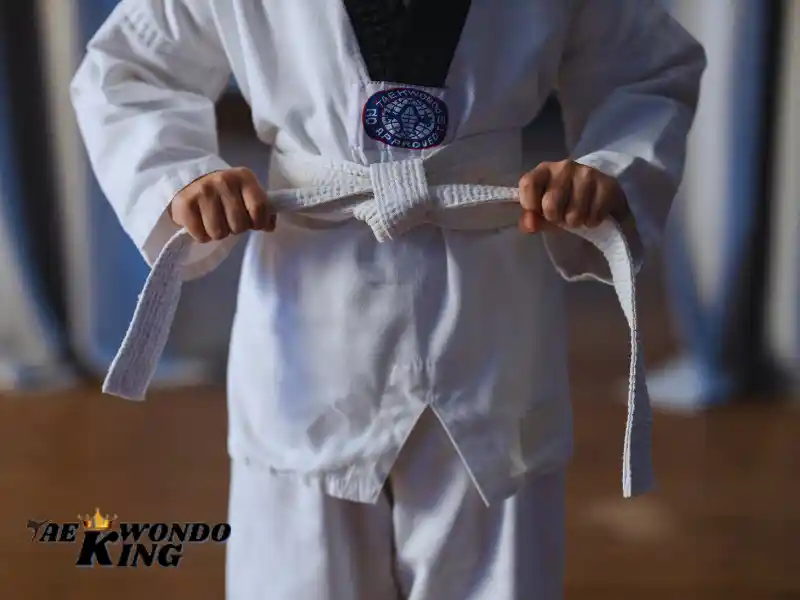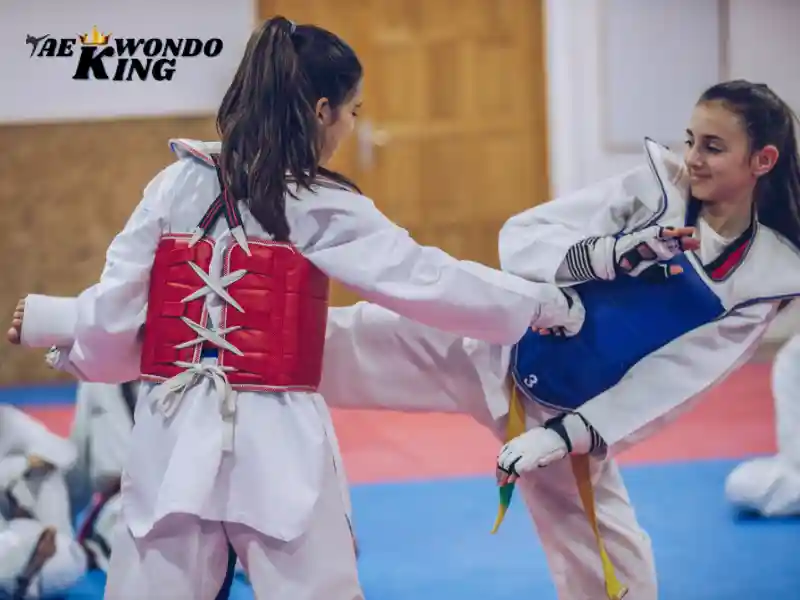
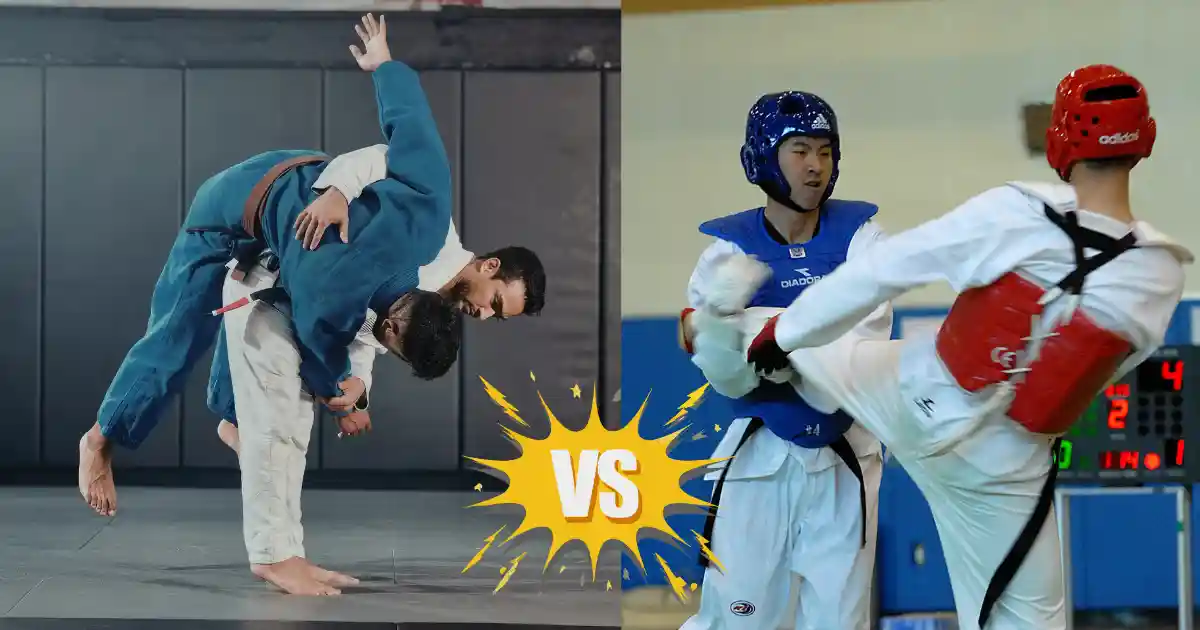
Gloves pop against pads in one gym. Down the street, two athletes calmly try to pin each other to the mat instead. I noticed this exact contrast on a Saturday morning in Denver, Colorado, watching a striking class and a grappling class run back to back. Both looked completely different, yet both demanded real skill, discipline, and patience. The striking vs grappling martial arts debate isn’t really about which one wins. It’s about which one fits your goals, your body, and your schedule. This guide breaks down both worlds so you can choose with confidence.
What Are Striking and Grappling Martial Arts?
Both styles teach self-defense and build real athletic skill, but they solve problems in very different ways. One focuses on striking distance, while the other focuses on controlling an opponent up close, a distinction that shows up clearly when you compare taekwondo and karate.
Definition of striking martial arts
Striking arts use punches, kicks, elbows, or knees to score points or stop an opponent. Distance and timing matter more than grip strength here.
Definition of grappling martial arts
Grappling arts use throws, pins, and submissions instead of strikes. Control and positioning replace punches and kicks as the main tools.
Shared principles
Both styles build discipline, respect, and real physical conditioning. Both also reward the same patience you’ll read about in reasons people keep practicing taekwondo.
Key differences
Striking rewards speed and distance control. Grappling rewards leverage, timing, and close-range control instead.
Popular Martial Arts in Each Category
Understanding which arts belong to each category makes comparing them much easier. Many gyms across the country offer a mix, similar to programs found at a well-run taekwondo academy.
Common striking martial arts
Several striking styles dominate gyms across the United States, each with its own flavor and rule set.
Taekwondo
Taekwondo focuses heavily on kicking technique, speed, and flexibility. Many students start here because of why taekwondo is so popular worldwide.
Karate
Karate blends striking with strong stances and disciplined forms. Comparing the two styles closely, you’ll find useful detail in taekwondo vs karate.
Boxing
Boxing focuses entirely on punches, footwork, and head movement. Fans often debate taekwondo against boxing since both prioritize speed differently.
Muay Thai
Muay Thai adds elbows, knees, and clinch strikes to the striking toolkit. It ranks among the more physically demanding striking arts you can train.
Kickboxing
Kickboxing blends boxing punches with kicking techniques from arts like taekwondo. The comparison in kickboxing vs taekwondo highlights how much overlap exists between the two.
Common grappling martial arts
Grappling styles focus on the clinch, the ground, or both, and each brings a different flavor to close-range combat.
Brazilian Jiu-Jitsu (BJJ)
BJJ specializes in ground control and submissions. It rewards patience and technique over raw strength.
Judo
Judo emphasizes throws and takedowns from a standing position. Many judo principles also appear in self-defense techniques taught across martial arts styles.
Wrestling
Wrestling builds elite takedown skill and positional control. It remains one of the most physically demanding grappling bases in combat sports.
Sambo
Sambo blends judo-style throws with submission holds from Russian military training. It offers a well-rounded grappling skill set.
Aikido
Aikido focuses on redirecting an opponent’s energy rather than overpowering them. It appeals to students drawn to a gentler, more flowing approach.
Table 1: Striking vs Grappling at a Glance
People often ask me which style is harder. Honestly, that’s like asking whether swimming is harder than climbing. They challenge you in different ways.
| Category | Striking Arts | Grappling Arts |
|---|---|---|
| Main Goal | Hit while avoiding hits | Control opponent |
| Distance | Long to medium | Close range |
| Common Techniques | Punches, kicks, elbows | Throws, pins, submissions |
| Competition Focus | Points or knockouts | Control or submissions |
| Examples | Taekwondo, Boxing | BJJ, Judo |
Core Techniques Compared
Every martial art has unique techniques, but striking and grappling build different movement skills entirely. Many of the kicking mechanics below connect closely to hard kicks in taekwondo.
Punching
Punches rely on hip rotation, timing, and hand speed. Boxing and kickboxing both build this skill heavily.
Kicking
Kicks require hip mobility, balance, and control at range. Taekwondo athletes train this more than almost any other style.
Elbows and knees
Muay Thai fighters use elbows and knees at close range when punches lose effectiveness. These strikes demand tight clinch control.
Throws
Throws use leverage and timing to put an opponent on the ground. Judo built an entire sport around perfecting this single skill.
Takedowns
Takedowns bring a standing opponent down through the legs or hips. Wrestlers train this technique more than any other group.
Joint locks
Joint locks apply pressure to a joint until an opponent submits. BJJ and Sambo both rely heavily on this category of technique.
Chokes
Chokes restrict blood flow or air to end a match safely. Proper tapping and safety awareness are essential parts of learning this skill.
Ground control
Ground control means maintaining position after a takedown or throw. BJJ practitioners spend years refining this single skill area.
Fitness Benefits of Each Style
Both categories provide excellent workouts, though they develop different physical qualities. Striking styles build the same fitness base described in taekwondo supercharging overall fitness.
Cardiovascular endurance
Striking arts push heart rate up quickly through fast combinations. Grappling builds cardio differently through sustained physical effort against resistance.
Functional strength
Grappling builds real functional strength through constant resistance against another person. Striking builds strength too, mostly through repeated explosive movement.
Flexibility
Kicking arts like taekwondo demand serious hip and hamstring flexibility. This connects directly to why flexibility matters so much in kick-based styles.
Balance
Both styles challenge balance constantly, though in different ways. Striking tests balance during kicks, while grappling tests it during transitions and scrambles.
Coordination
Striking sharpens hand-eye and foot-eye coordination through combinations. Grappling sharpens coordination through complex body positioning instead.
Mobility
Joint mobility supports safer, more powerful movement in both categories. A basic mobility and recovery kit helps athletes in either style stay loose between sessions.
Mental resilience
Both styles build mental toughness through repeated pressure and challenge. This resilience often carries into building self-confidence outside the gym too.
Table 2: Fitness Comparison
One friend leaves boxing class soaked with sweat. Another finishes Brazilian Jiu-Jitsu covered in mat dust instead. Both insist they had an amazing workout.
| Fitness Goal | Striking | Grappling |
|---|---|---|
| Cardio | Excellent | Very Good |
| Strength | Good | Excellent |
| Flexibility | Excellent | Good |
| Grip Strength | Moderate | Excellent |
| Agility | Excellent | Good |
| Endurance | Excellent | Excellent |
Self-Defense Comparison
Real-life self-defense situations are unpredictable. Different martial arts prepare practitioners for different scenarios, a topic covered thoroughly in the secret of taekwondo self-defense.
Distance management
Striking arts train you to control distance and avoid being grabbed. This skill matters most in the opening seconds of a confrontation.
Escaping grabs
Grappling arts teach specific escapes from grabs and holds. This fills a gap that pure striking styles sometimes leave open, as discussed in whether taekwondo is useless for self-defense.
Staying on your feet
Many striking stylists prioritize staying upright and mobile. This approach works well against a single attacker in open space.
Ground situations
Grappling skills become essential once a fight goes to the ground. Ignoring this range leaves a real gap in overall self-defense preparation.
Multiple-attacker considerations
Staying on your feet and mobile matters most against multiple attackers. Ground grappling becomes far riskier in that specific scenario.
Situational awareness
No martial art replaces awareness and early de-escalation. Physical skill only matters once avoiding a situation is no longer possible.
Important: The safest self-defense outcome is avoiding violence whenever possible. De-escalation and leaving the situation are often the best options.
Learning Curve for Beginners
Every beginner starts somewhere. Some skills feel natural immediately, while others require more repetition, much like the early experience described in taekwondo for beginners.
First few weeks
Early weeks focus on stance, basic movement, and safety rules. Both striking and grappling schools ease new students in gradually.
Basic movements
Striking beginners learn footwork and basic strikes first. Grappling beginners learn falls, base, and basic control positions instead.
Common beginner challenges
Coordination and timing challenge nearly every new student at first. This is completely normal and improves quickly with consistent practice.
Sparring introduction
Light sparring usually starts once basics feel comfortable. Good coaches introduce contact gradually to protect confidence and safety.
Building confidence
Confidence grows steadily through small wins in both styles. This mirrors the confidence-building process covered in reasons for high self-esteem in taekwondo.
Injury Risks and Safety
Every contact sport carries some injury risk. Smart coaching and proper safety practices help reduce those risks significantly, a priority reflected in official taekwondo safety and medical rules.
Common striking injuries
Bruises, shin soreness, and hand injuries show up often in striking arts. Most of these injuries covered in common taekwondo injuries come from overuse rather than single incidents.
Common grappling injuries
Joint strains, especially in the shoulders and knees, appear frequently in grappling arts. Proper tapping and controlled partners reduce this risk considerably.
Warm-up importance
A proper warm-up prepares muscles and joints for the demands of either style. Skipping this step raises injury risk in both striking and grappling equally.
Protective equipment
Mouthguards, shin guards, and headgear protect striking athletes. Grapplers benefit from mats, ear guards, and proper mat hygiene instead.
Recovery habits
Recovery matters just as much as training itself. A simple foam roller and mobility set supports recovery for athletes in either discipline.
Training with experienced partners
Training with controlled, experienced partners reduces injury risk dramatically. New students benefit most from patient, safety-focused training partners.
Table 3: Common Injuries by Style
I’ve noticed something funny. Ask ten martial artists where they’re sore, and you’ll probably get ten different answers.
| Striking Arts | Grappling Arts |
|---|---|
| Bruises | Finger strains |
| Shin soreness | Shoulder strains |
| Foot injuries | Knee sprains |
| Hand injuries | Neck soreness |
| Muscle tightness | Elbow irritation |
Competition Rules and Scoring
Competition formats vary widely depending on the martial art and governing organization. Taekwondo competitions, for example, follow detailed kyorugi rules set by World Taekwondo.
Point scoring
Striking sports often score clean, controlled strikes to legal target areas. Points accumulate over rounds until a winner emerges.
Knockouts
A knockout ends a match immediately when a fighter cannot continue safely. Referees monitor closely to stop matches before serious harm occurs.
Throws
Grappling competitions often award points for clean, controlled throws. A powerful throw can even end a judo match outright.
Submissions
Submissions end a match when an opponent taps to a joint lock or choke. This remains the primary win condition in BJJ competition.
Referee stoppages
Referees stop matches when a competitor cannot safely continue. Safety always takes priority over finishing a scheduled match.
Weight classes
Weight classes keep competition fair across nearly every combat sport. This system connects closely to standard taekwondo weight limit rules.
Can You Train Both?
Many athletes combine striking and grappling to build a broader skill set and improve overall fitness. This cross-training approach echoes ideas from taekwondo not being just about fighting.
Cross-training benefits
Cross-training builds a more complete, adaptable skill set. Athletes also avoid boredom by mixing up their weekly training routine.
Weekly training example
A balanced weekly schedule blends both styles without overwhelming your recovery capacity.
Beginner schedule
Beginners might attend two striking classes and one grappling class weekly. This ratio allows steady progress without overwhelming a new student.
Intermediate schedule
Intermediate students often train three to four sessions weekly across both styles. Recovery days become more important as volume increases.
Competitive athlete schedule
Competitive athletes may train five to six sessions weekly, carefully balancing both disciplines. Planning here matters as much as the training itself.
Managing recovery
Recovery becomes critical once you’re training two different demanding styles. Sleep, nutrition, and planned rest days protect long-term progress.
Avoiding overtraining
Combining two demanding styles raises overtraining risk if volume isn’t managed carefully. Watching for fatigue early prevents bigger setbacks down the road.
Table 4: Sample Cross-Training Schedule
One training partner joked that Monday was “kick day” and Wednesday was “get folded into a pretzel day.” Everyone at the gym knew exactly what he meant.
| Day | Training |
|---|---|
| Monday | Striking class |
| Tuesday | Strength training |
| Wednesday | Grappling class |
| Thursday | Mobility recovery |
| Friday | Mixed skills |
| Saturday | Optional conditioning |
| Sunday | Rest |
A resistance band and roller set like this training and mobility kit fits well into Thursday’s mobility recovery day.
Which Martial Art Fits Your Goals?
Your best choice depends on what motivates you, your personality, and your long-term goals. Many students start simply because of why you should start taekwondo or a similar personal reason.
Fitness
If pure fitness drives you, either style delivers a serious workout. Choose whichever style you’ll actually enjoy attending consistently.
Self-defense
A blend of striking and grappling covers the widest range of self-defense scenarios. Pure striking or pure grappling each leave one range less covered.
Competition
Competitive goals often point toward a single focused discipline. Specializing usually beats splitting attention across too many styles at once.
Weight loss
Both styles burn serious calories through intense, varied movement. Consistency matters more than which style you pick for weight loss goals.
Confidence
Progressing through skill levels builds confidence steadily in either style. This mirrors the confidence growth found in dedicated taekwondo training programs.
Family-friendly training
Many schools offer both styles in family-friendly formats for kids and adults together. Programs like the ones in teaching kids taekwondo show how approachable martial arts training can be.
Lifelong learning
Both striking and grappling offer decades of skill to refine. Neither style runs out of depth, even for advanced, experienced athletes.
USA Expert Advice on Choosing a Martial Art
“The best martial art is the one you enjoy enough to practice consistently and safely.” — Dr. Jordan Metzl, MD, Sports Medicine Physician (USA)
Choose a supportive gym
A supportive, safety-focused gym matters more than the specific style you choose. Good coaching shapes your entire experience.
Focus on consistent attendance
Consistency beats intensity for long-term progress in any martial art. Showing up regularly matters more than occasional hard sessions.
Prioritize good coaching
Skilled, patient coaching accelerates progress and reduces injury risk. Seek out instructors who explain the reasoning behind each technique.
Respect recovery
Recovery protects the progress you build through consistent training. This principle applies equally to striking and grappling athletes.
Be patient with progress
Skill develops gradually, not overnight, in either discipline. Patience protects both motivation and long-term physical health.
Real-life context: Visit martial arts schools around California, Texas, or Florida on a Tuesday evening and you’ll notice something interesting. One room echoes with kick pads, while another stays surprisingly quiet as grapplers work through techniques. Different sounds. Same dedication. One instructor laughed, “Everyone leaves tired, we just arrive there differently.”
Frequently Asked Questions
What is the difference between striking and grappling?
Striking focuses on punches and kicks at a distance, while grappling focuses on controlling an opponent up close. Both build serious skill in very different ranges.
Which style is better for beginners?
Neither style is universally easier for beginners. Choose based on which movements and gym culture feel more natural to you.
Is Taekwondo a striking martial art?
Yes, Taekwondo is a striking art that focuses heavily on kicking technique. It also builds flexibility, speed, and balance.
Is Brazilian Jiu-Jitsu a grappling martial art?
Yes, BJJ is a grappling art centered on ground control and submissions. It relies on leverage and technique over raw strength.
Which burns more calories?
Both styles burn significant calories during an active class. Total calorie burn depends more on intensity and class length than style alone.
Which is better for self-defense?
A combination of both styles covers the widest range of self-defense scenarios. Relying on only one range leaves some situations less prepared for.
Can I learn both styles?
Yes, many athletes successfully train both striking and grappling together. Managing recovery becomes more important as combined training volume increases.
Which has a steeper learning curve?
Both styles have their own learning curves in different areas. Striking often challenges timing first, while grappling often challenges positioning first.
Which is safer?
Both styles carry manageable injury risk with proper coaching and safety equipment. Overall safety depends more on the gym’s culture than the style itself.
How do I choose the right martial art?
Try a class in each style before committing. Your enjoyment and the coaching quality matter more than any single feature of the style itself.
Final Recommendation
After training and observing both worlds firsthand, my take on striking vs grappling martial arts stays simple and honest. Neither style beats the other across the board, and each one rewards a different kind of patience and skill. If you want speed, flexibility, and distance control, striking arts like taekwondo or boxing deliver that well. If you want control, leverage, and ground confidence, grappling arts like BJJ or judo fit that goal better. My real recommendation is to try both before choosing, then commit fully to whichever one keeps you showing up week after week. Consistency, not category, is what actually builds real skill over time.

Founder, Owner, and CEO of TaekwondoKing.
He is one of the top 100 martial artists in the World and among the top 20 referees in Bangladesh.
Ehatasamul Alom is an esteemed Kukkiwon Certified Taekwondo 3rd Dan Black Belt with over 15 years of experience in this dynamic martial art. Born in Rajshahi, Bangladesh, Ehatasamul’s journey with Taekwondo began at the tender age of seven. His passion led him to compete at national and international levels, where he has bagged numerous awards and honors. He is also a member of the Taekwondo National Referee Panel.
With a Bachelor’s degree in Sports Science from the prestigious Rajshahi University, Ehatasamul has a deep understanding of the technical and scientific aspects of martial arts and some other martial arts.
In 2022, Ehatasamul created the “TaekwondoKing.com” to share his knowledge, Free Resources, Values, and Real experiences. His articles focus on Taekwondo training techniques, competition strategies, Sport Products Reviews, and the art’s rich history and philosophy. He also writes about the importance of mental fortitude and discipline, key aspects of his teaching philosophy. He has already launched many sports, Taekwondo, and health-related Free online tools. His goal is to inspire both beginners and seasoned practitioners worldwide through insightful and engaging content.
If you need any help, contact Ehatasamul Alom at any time.