Most people picture a spinning head kick when they think of taekwondo. I did too. Then I stepped into my first serious sparring round and got tagged by a plain front-leg kick I never saw coming. That moment changed how I think about how to fight taekwondo style.
This guide covers what actually works in sparring. You will learn stance, footwork, kicks, scoring, defense, and training habits. I will also share the mistakes I made, so you can skip a few of them.
What “Taekwondo Style” Fighting Really Means
Taekwondo style fighting is a kick-first approach to sparring. You use distance, speed, and timing instead of trading hard punches. The goal is to land clean techniques while staying out of reach.
That sounds simple. It is not. The style rewards patience, and patience is hard when someone is bouncing in front of you.
Why It Looks Different From Boxing or Muay Thai
Boxers work close and use their hands. Muay Thai fighters clinch, knee, and elbow. Taekwondo fighters mostly stay at long range and use their legs.
Your legs are longer than your arms. That is the whole idea. You can hit from farther away, but you also have to move more.
Sport Sparring vs. Self-Defense vs. Forms
People mix these up all the time. I did for years. Each one trains something different.
| Training Type | Main Focus |
|---|---|
| Kyorugi (sport sparring) | Scoring points with timing and distance |
| Poomsae (forms) | Technique, balance, and control |
| Self-defense drills | Escapes, blocks, and quick strikes |
This article focuses on kyorugi. That is what most people mean when they ask how to fight taekwondo style.
WT vs. ITF Sparring
There are different taekwondo organizations, and their rules are not the same. World Taekwondo (WT) is the one used in the Olympics. ITF-style groups use different rules.
I’m not certain about every rule difference, and rules change over time. Check your own federation’s current rulebook before you compete. Everything below leans on WT-style sparring, since that is the most common.
How to Fight Taekwondo Style Starting With Your Stance
Your stance is your base. If it is sloppy, every kick after it gets weaker. I ignored this for far too long.
Good stance gives you three things. You can move fast, kick quickly, and defend without thinking.
The Fighting Stance Basics
Stand sideways to your partner. Put one foot forward and one back. Keep your knees soft and your weight light.
Do not plant your feet like tree trunks. Stay on the balls of your feet. Small movements keep you ready.
Hand Position Matters More Than You Think
Here is my biggest early mistake. I dropped my hands because “taekwondo is about kicks.” Then I got hit in the face.
Keep your hands up near your chin and chest. They protect you and help your balance. Your hands also hide your next move.
Bouncing and Rhythm
Bouncing is not just for show. It keeps your legs loose. It also hides the exact moment you attack.
A steady rhythm makes you easy to read. So mix it up. Bounce, pause, shift, then go.
Common Stance Mistakes
Here are the stance problems I see most often, including some I had myself.
| Mistake | Better Approach |
|---|---|
| Standing too square to the opponent | Turn your body slightly sideways |
| Hands hanging low | Keep them near your chin |
| Flat, heavy feet | Stay light on the balls of your feet |
| Leaning back to avoid contact | Keep your weight centered |
| Freezing in place | Use small, steady movement |
Footwork: The Part Nobody Wants to Practice
I used to skip footwork drills. They felt boring. Kicks felt exciting.
Then I noticed something. The better fighters did not kick more than me. They simply arrived at the right spot first.
Controlling Distance
Distance is the heart of taekwondo style fighting. Too close, and you can’t kick well. Too far, and you can’t reach.
Your job is to stay just outside your opponent’s range. Then you step in, kick, and leave. Think of it as a quick visit, not a long stay.
Stepping In and Out
There are a few basic ways to move. Each one has a purpose.
- Forward step: closes distance to attack.
- Back step: creates space to reset or counter.
- Side step: changes your angle.
- Slide step: closes distance quickly without a big movement.
Practice these slowly first. Speed comes after control.
Using Angles
Straight lines are easy to defend. Angles are not. If you step slightly to the side before you kick, your opponent has to adjust.
This helped me more than any new kick did. A simple roundhouse feels new when it comes from a different angle.
Footwork Drills Worth Your Time
You do not need fancy equipment. A bit of floor space is enough.
| Drill | What It Builds |
|---|---|
| Shadow sparring | Rhythm and distance awareness |
| Line drills | Straight-line speed and control |
| Partner mirror drills | Reaction and spacing |
| Cone or tape footwork | Angles and balance |
Kicks That Actually Land in Sparring
Taekwondo has many kicks. Only a few show up in real sparring again and again. I learned this the hard way.
Focus on the basics first. Flashy techniques only work when the basics are already solid.
The Roundhouse Kick (Dollyo Chagi)
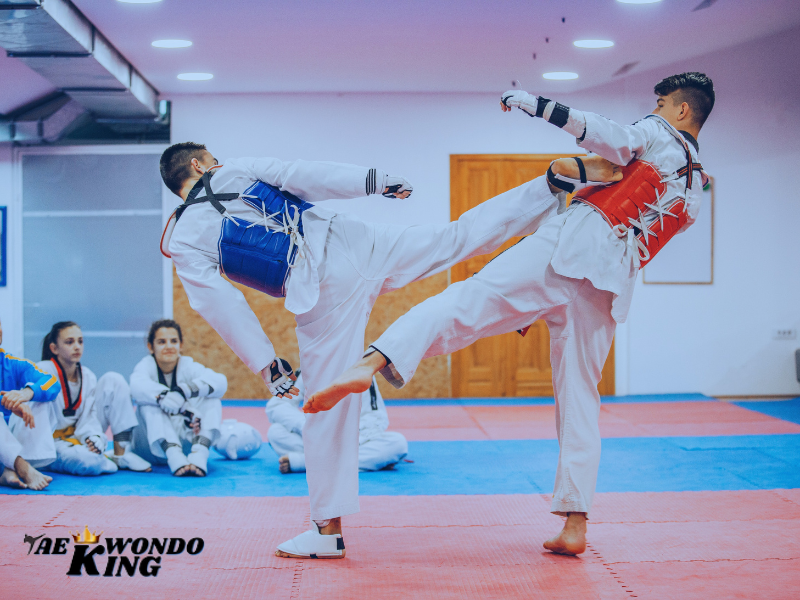
This is the workhorse of taekwondo sparring. It is fast, flexible, and works at many ranges. Most fighters use it more than any other kick.
Pivot on your supporting foot. Turn your hip over. Snap the kick and bring it back quickly. Do not leave your leg out there.
The Front-Leg Kick
Remember the kick that got me in my first round? This was it. A quick kick from your lead leg is hard to read.
It is not powerful. But it is fast, and it scores or sets up your next move. It also keeps your opponent honest.
Back Kick, Axe Kick, and Spinning Techniques
These are harder. They can be effective, but they carry more risk. If you miss, you turn your back to your opponent.
I used to throw spinning kicks too early in a round. Most of them missed. Now I wait for the right moment.
Kick Comparison
Here is a rough guide to when each kick tends to work best.
| Kick | Best Use | Main Risk |
|---|---|---|
| Roundhouse | Everyday scoring and counters | Easy to read if predictable |
| Front-leg kick | Setups and quick points | Lower power |
| Back kick | Counters when opponents rush | Exposes your back if it misses |
| Axe kick | Surprise attacks to the head area | Slow and easy to see coming |
Chambering and Recovery
Chamber means lifting your knee before you extend your leg. A good chamber hides the kick. It also makes it faster.
Recovery matters just as much. After you kick, bring your leg back and reset your stance. I lost many points by admiring my own kicks.
Fighting Taekwondo Style Under Scoring Rules
If you plan to compete, you need to know how scoring works. Fighting well and scoring well are not always the same thing. I learned that after a few frustrating losses.
Rules also change. What I describe here is my understanding of WT-style rules, and it may be out of date. Please verify with the current official rulebook.
How Points Generally Work
In WT-style sparring, legal targets are typically the trunk and the head. Kicks and certain punches score, depending on the rules. Head kicks usually earn more than body kicks.
As far as I know, the approximate scoring looks like this. Treat it as a starting point and confirm it.
| Target or Technique | Approximate Score (Verify) |
|---|---|
| Punch to the trunk | 1 point |
| Kick to the trunk | 2 points |
| Kick to the head | 3 points |
| Spinning kick to the trunk | Higher than a standard kick |
| Spinning kick to the head | Highest score available |
I am not fully certain of every value. Rules and electronic scoring settings can change by event.
Electronic Scoring Gear
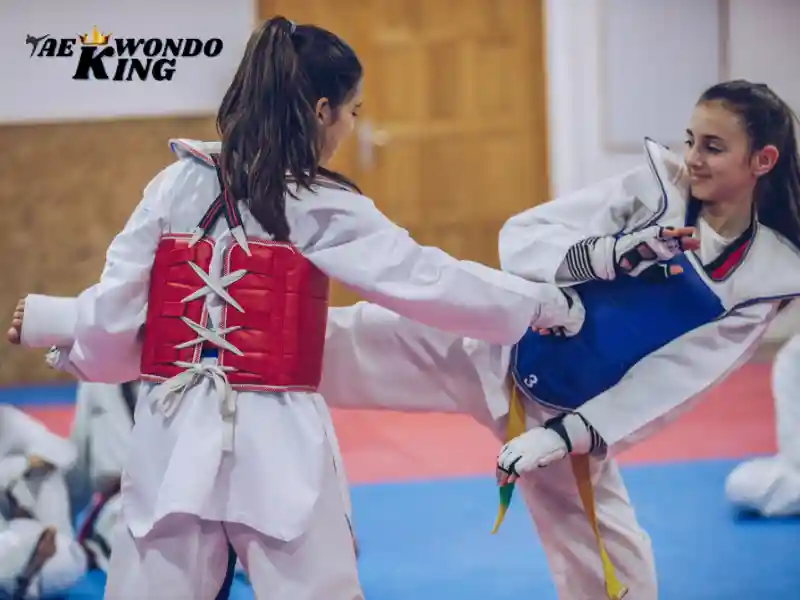
Many competitions use electronic protectors on the trunk. Some also use sensors in the headgear. This changes strategy.
A kick has to hit with enough force to register. Light touches may not count. So you need clean contact, not just fast taps.
Why Aggression Alone Does Not Work
Early on, I thought more attacks meant more points. I was wrong. Rushing in gave my opponents easy counters.
Smart fighters pick their moments. They wait, read, and strike when the opening is real.
Setting Up Your Attacks
A single kick rarely scores against a good opponent. They see it coming. You need to set it up.
Setups are small tricks that change what your opponent expects. They make real attacks work.
Fakes and Feints
A feint is a fake attack. You show a kick, then do something else. Your opponent reacts, and that reaction opens a gap.
Keep feints small. A big, slow fake looks fake. A quick shoulder drop or knee lift can be enough.
Counterattacking
Counters are a favorite of many experienced fighters. You let your opponent attack first. Then you hit them while they are open.
This takes patience. I struggled with it for months. Watching for rhythm helped a lot.
Combining Techniques
Two or three techniques in a row can overwhelm a guard. A simple example is a front-leg kick followed by a roundhouse.
Do not memorize long combos. Short, practical sequences work better in live sparring.
Defense That Actually Works
Defense gets less attention than offense. That is a mistake. A good defense gives you better chances to counter.
I used to think blocking was old-fashioned. It is not. It is just different in sparring than it is in forms.
Blocking and Checking
In sparring, you do not use big forms-style blocks. You use small, quick movements. You check kicks with your lead leg or arms.
Checking a kick also interrupts your opponent’s rhythm. That gives you a chance to attack next.
Moving Out of Range
Often the best defense is not being there. A small step back can make a kick miss completely.
Then you counter. This is the most efficient way to fight taekwondo style. You waste less energy and you score more.
Staying Calm Under Pressure
When someone rushes you, panic takes over. I know that feeling well. My early rounds felt like a blur.
Breathing helped. So did practicing with a calm partner who rushed me slowly. Over time, the panic faded.
Conditioning and Flexibility
Technique is only part of the story. Your body has to keep up. Tired fighters make sloppy mistakes.
I found out the hard way that skills fade fast when your legs are done.
Flexibility Without Overdoing It
You need decent hip flexibility for high kicks. But forcing stretches can cause injuries. I strained a muscle once by pushing too hard.
Warm up first. Stretch gently. Be patient, since flexibility improves slowly.
Cardio and Leg Strength
Sparring is stop-and-go. Short bursts of speed, then brief rest. Training that matches this pattern helps.
Leg strength also protects your knees. Bodyweight exercises like squats and lunges are a good start.
Injury Prevention Basics
Taekwondo fighters often get hurt in the legs, ankles, and feet. Rest and recovery matter. Wear proper protective gear in sparring.
If something hurts in a sharp or unusual way, stop. I’m not a doctor, so see a professional if pain does not go away.
Myths About Taekwondo Fighting
There is a lot of bad information out there. Some of it comes from movies. Some of it comes from stubborn habits.
Here are a few myths I believed myself.
| Myth | Reality |
|---|---|
| Taekwondo is only about high kicks | Many points and setups come from simple, lower kicks |
| You must be very flexible to spar well | Flexibility helps, but timing and distance matter more |
| Hands do not matter | Your hands protect you and help with balance |
| More attacks win more points | Well-timed attacks win more points |
| Forms and sparring are the same | They train different skills |
A Simple Weekly Training Plan
You do not need to train all day. A steady routine beats random hard sessions. Here is a simple layout that has worked for people I know.
Adjust it to your schedule, your level, and your coach’s advice.
| Day | Focus |
|---|---|
| Day 1 | Footwork and distance drills |
| Day 2 | Kick technique on pads |
| Day 3 | Light sparring and setups |
| Day 4 | Rest or gentle stretching |
| Day 5 | Conditioning and leg strength |
| Day 6 | Full sparring with a partner |
| Day 7 | Rest |
Frequently Asked Questions
These are some questions people often ask about how to fight taekwondo style.
How do you fight taekwondo style as a beginner?
Start with stance, footwork, and two or three basic kicks. Skip fancy techniques at first. Spar lightly with a trusted partner and a coach.
Is taekwondo good for a real street fight?
I can’t say for sure. Sport sparring and real fights are very different. Taekwondo can build timing, fitness, and confidence, but it is not a guarantee. Avoiding fights is always the safer choice.
How long does it take to get good at sparring?
It depends on how often you train and how you train. I’m not able to give a reliable number. Most people improve steadily over months and years, not days.
Do you need to be flexible to fight taekwondo style?
Not extremely. Flexibility helps with high kicks, but you can score with timing and control. Build flexibility slowly and safely.
Final Thoughts
If I had to sum up how to fight taekwondo style, I’d say this: distance, timing, and patience beat flashy moves. The best fighters I know make the sport look calm. They are not rushing. They are waiting for the right moment.
Be realistic about your progress. You will lose rounds. You will miss kicks. That is part of learning. Find a good coach, train steadily, and enjoy the process. Check the current rules for your event before competing.

Founder, Owner, and CEO of TaekwondoKing.
He is one of the top 100 martial artists in the World and among the top 20 referees in Bangladesh.
Ehatasamul Alom is an esteemed Kukkiwon Certified Taekwondo 3rd Dan Black Belt with over 15 years of experience in this dynamic martial art. Born in Rajshahi, Bangladesh, Ehatasamul’s journey with Taekwondo began at the tender age of seven. His passion led him to compete at national and international levels, where he has bagged numerous awards and honors. He is also a member of the Taekwondo National Referee Panel.
With a Bachelor’s degree in Sports Science from the prestigious Rajshahi University, Ehatasamul has a deep understanding of the technical and scientific aspects of martial arts and some other martial arts.
In 2022, Ehatasamul created the “TaekwondoKing.com” to share his knowledge, Free Resources, Values, and Real experiences. His articles focus on Taekwondo training techniques, competition strategies, Sport Products Reviews, and the art’s rich history and philosophy. He also writes about the importance of mental fortitude and discipline, key aspects of his teaching philosophy. He has already launched many sports, Taekwondo, and health-related Free online tools. His goal is to inspire both beginners and seasoned practitioners worldwide through insightful and engaging content.
If you need any help, contact Ehatasamul Alom at any time.